
Faster Bikes, Safer Streets: Rotterdam Experiments with the Future of (E-)Cycling
Written by: Chris Bruntlett
The introduction of the electric-assist bicycle has been an overwhelmingly positive development for cities across the Netherlands and around the world. By making cycling accessible to more people, regardless of age, fitness or physical ability, e-bikes are helping to expand the cycling population, extend the distances people are willing to travel, and make every day journeys by bicycle a more attractive alternative to driving. They flatten hills, make longer trips more manageable, and remove much of the concern about arriving at a destination hot and sweaty.
In short, e-bikes are helping cities unlock cycling’s enormous potential as an inclusive, healthy and efficient form of mobility. Yet their growing popularity also presents a challenge, particularly in the Netherlands, where it has become so successful the space available on existing infrastructure is struggling to accommodate everyone comfortably.
When cycling success creates new challenges
On busy Dutch cycle paths, differences in speed, acceleration and size are becoming increasingly noticeable. Traditional bikes now share limited space with electric bikes, speed-pedelecs, cargo bikes, fat-tire bikes, food-delivery riders and recreational cyclists travelling at higher speeds. Each serves a legitimate mobility need, but their coexistence can create friction, particularly on narrow routes during peak hours.
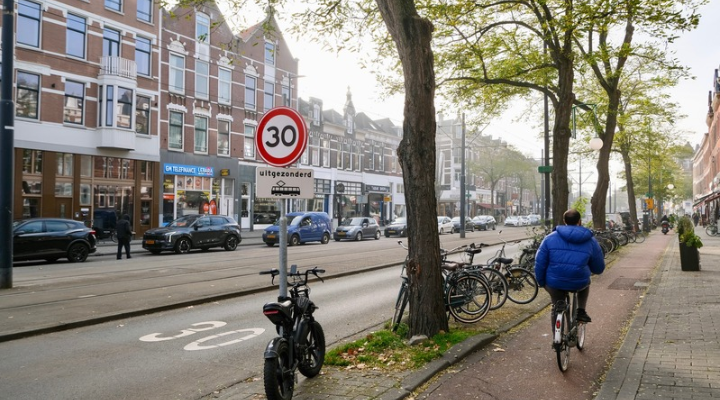
The consequences extend beyond collisions and injuries, which remain important safety concerns. There is also a less visible impact: the potential loss of confidence among those who may already have hesitations moving on our streets. Children learning to cycle, older adults, people with disabilities and those who simply prefer a relaxed pace may find themselves increasingly uncomfortable sharing space with faster, heavier bikes.
If these people decide cycling is no longer a pleasant option, we risk undermining the inclusivity that makes Dutch cycling culture so successful. Municipalities across the country are therefore exploring how to accommodate a more diverse cycling ecosystem without compromising its convenience and appeal. Rotterdam, a city with a proud tradition of urban experimentation, offers an interesting idea of how that might be done.
A small experiment with potentially big lessons
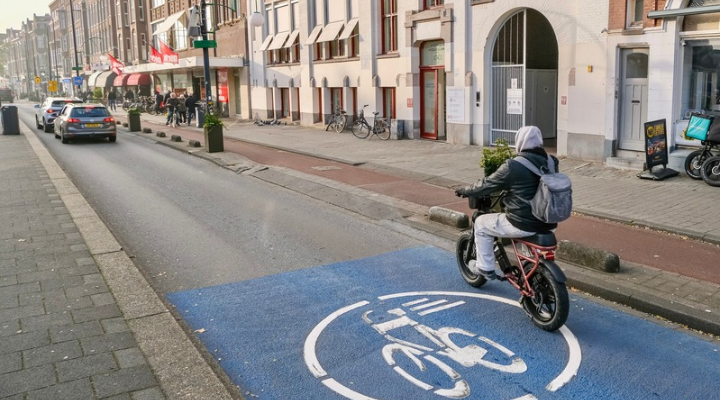
In November 2026, Rotterdam introduced a pilot project along a 200-metre stretch of Middellandstraat following a request from the Middelland-Nieuwe Westen neighbourhood council. Running until March 2027, the trial encourages cyclists travelling faster than 20 kilometres per hour to use the roadway rather than the adjacent existing cycle path. Temporary signs and road markings communicate the new arrangement to users.
The idea is straightforward: give faster cyclists an alternative while freeing up valuable space on the bike path for people riding at a slower pace. Instead of trying to accommodate every speed and bike type within a single, increasingly crowded strip of asphalt, the pilot explores whether a more flexible spatial allocation can improve everyone’s experience.
Crucially, this is only possible because the speed limit for motor traffic along the corridor has already been reduced to 30 kilometres per hour. That environment makes it more feasible for some cyclists to share the roadway with motor vehicles, although the actual safety and comfort of doing so must be evaluated carefully.
This is an important distinction. Asking cyclists to leave a segregated path would not normally represent progress. The underlying traffic conditions matter enormously. A lower speed limit, appropriate street design, clear communication and considerate user behaviour all contribute to whether such an arrangement can work in practice.
Of course, the ideal long-term solution would be to redesign the street entirely and widen the cycle path. But comprehensive reconstruction requires funding, support, planning and time. In the meantime, cities need practical ways to address emerging challenges using the streets they already have. Rotterdam’s pilot offers an opportunity to test one such approach before committing to a more permanent intervention.
Learning by doing: a Dutch tradition
What makes this experiment particularly interesting is not simply the proposed solution, but the willingness to test it, learn from it and adapt. After March 2027, the municipality intends to evaluate the trial, considering the experiences of residents and users and whether the situation has in fact become safer and more pleasant. These questions should be central to any assessment. Has the cycle path become more comfortable for slower riders? Do faster cyclists feel they have a viable alternative? How do pedestrians, motorists and other users experience the change? Have any new conflicts emerged?
The answers will help determine whether the arrangement should continue, be adjusted or abandoned. Just as importantly, documenting the results can help other municipalities understand which elements might be transferable to their own streets.
This spirit of experimentation has deep roots in Dutch history. In the 1970s, cities did not have a blueprint for creating the cycling-friendly environments for which the country is now famous. Planners experimented with street layouts, traffic circulation, restrictions to access, and the allocation of space. Some ideas worked better than others, and the successes gradually informed a scalable set of best practices.
Today, the challenge is different, but the underlying principle remains the same. As e-bikes and other forms of micromobility reshape how people travel, cities must continue adapting their streets to changing needs to remain safe, liveable and accessible.
An opportunity for cities around the world
Above all, Rotterdam’s experiment creates an opportunity for international cities. By observing these pilot projects happening now, they can learn from both their successes and shortcomings, incorporating those lessons into their own infrastructure and policies before ridership grows and congestion and conflicts become more widespread.
However, there is no guarantee this approach will prove universally applicable. Street widths, traffic volumes, local regulations, cycling cultures and the needs of users vary considerably between places. At the same time, a relatively inexpensive pilot should not become an excuse to postpone the investment needed for safe, high-quality cycling infrastructure. Nevertheless, such a carefully designed experiment can generate useful evidence, stimulate public discourse and help decisionmakers make more informed choices.
The Middellandstraat test may cover just 200 metres, but its impacts could potentially be huge; contributing to a broader conversation about the future of urban mobility. As global cities struggle with the transition from traditional to electrical cycling, this next chapter will be shaped by the trailblazers that are willing to experiment, share their findings and learn from one another. Rotterdam offers one small but meaningful contribution to that collective effort.
Share your story
Do you have an innovation, research results or an other interesting topic you would like to share with the professionals in the infrastructure, traffic management, safety, smart mobility and parking industry? The Intertraffic website and social media channels are a great platform to showcase your stories!
Please contact our Sr Brand Marketing Manager Carola Jansen-Young.
Are you an Intertraffic exhibitor?
Make sure you add your latest press releases to your Company Profile in the Exhibitor Portal for free exposure.

Intertraffic Amsterdam presents its largest edition ever - Smart. Safe. Sustainable.
14 January 2026

Intertraffic expands to Southeast Asia with launch of Intertraffic Asia in Bangkok
11 March 2026

Nominees Intertraffic Awards 2026 announced - pioneering mobility innovations
16 January 2026

Intertraffic Amsterdam 2026 – Impact van AI en robotica op mobiliteit
26 February 2026
Intertraffic Amsterdam 2026 concludes with global momentum and real-world impact
26 March 2026
Get up to speed on the mobility industry - our newsletter straight to your inbox!