
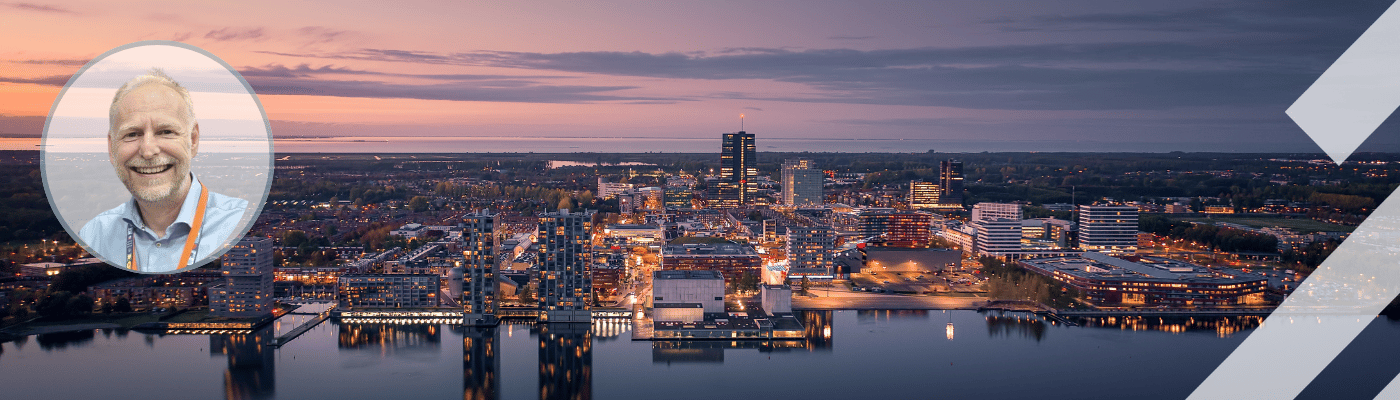
A model city: interview with Gerry de Koning
How do you design a city’s transport system from scratch? Almere was created as a commuter satellite to Amsterdam in the 1970s and Gerry de Koning, its smart mobility manager, has worked for the governing Gemeente Almere for more than half of its brief but noteworthy history. Here he talks to Christopher Court-Dobson about the transportation challenges the city has overcome, and the ones it is preparing for in the future. This article was first published in the 2026 edition of Intertraffic World magazine.
Almere is an anomaly in a country where most city-dwellers must contend with medieval street patterns and the hotchpotch inefficiencies of infrastructure accumulated over centuries. Built from scratch on reclaimed land in the 1970s, Almere only turned 50 last year.
For Gerry de Koning, smart mobility manager at its governing authority Gemeente Almere, municipal youthfulness has distinct advantages.
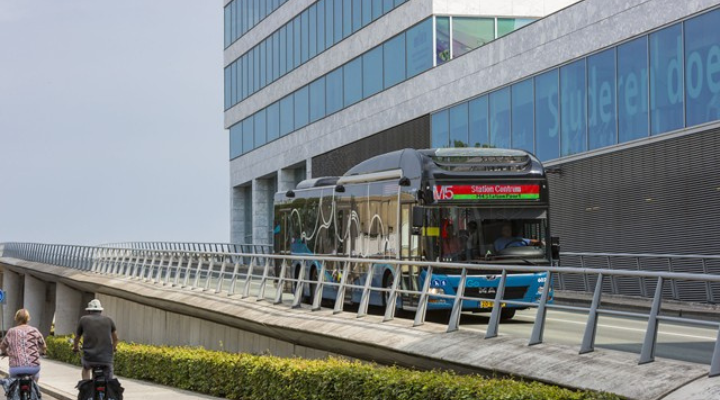
Almere’s design separates buses and cyclists from cars not merely in segregated lanes, but on bus roads and cycle paths which diverge entirely and seldom run alongside roads carrying regular car traffic. “Everything is separated,” says de Koning. “Driving is so simple that people have to take their driving test in other cities, where modes are more combined. It’s fairly unique in the Netherlands. Of course, it costs more to have separate bus infrastructure.”
“Everything is separated here. Driving is so simple that people have to take their driving test in other cities, where modes are more combined”
New residential developments are still being built in Almere – Gemeente Almere starts running bus services to these areas even before citizens move in, to discourage second car purchases and subsequent car dependency. “We’re pre-investing in safety,” says de Koning. “Because modes are separated, Almere is the safest city in the Netherlands.”
Cyclists benefit from dedicated infrastructure dating from Almere’s 1970s inception, replete with bridges and tunnels, which often take more direct routes than cars. Cyclists face the greatest risk on a single 3km street with confluent modes – which Gemeente Almere is currently redesigning.
“Our policy approach is very different to more car-focused municipalities,” says de Koning, nonetheless noting that municipal steering depends on which party is elected. “We don’t set targets ourselves. We provide digital tools which are neither right- or leftwing, then the governing party decides at what level KPIs should be targeted.”
Whereas traditional transport models may prioritize average users, de Koning is focused on ensuring the system works for everyone. “If you can’t afford a car or walk to a bus stop, you’re stranded,” he says. “We’re studying how to design for those groups. We want to create spaces away from roads for kids to play. That’s not something most traffic models consider.”
Cauliflower geometry
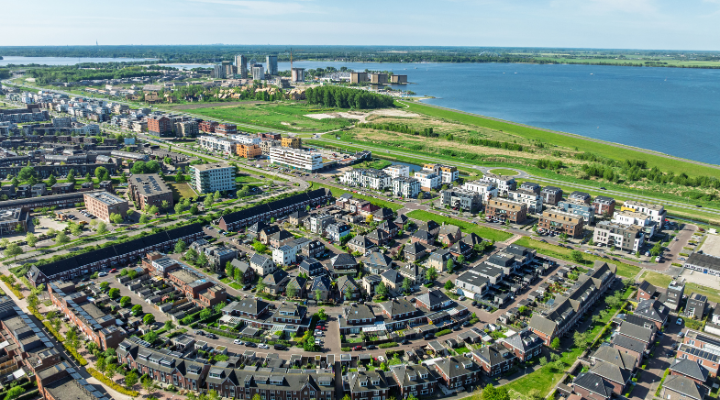
Almere’s garden city design employs cauliflower urban geometries wherein arterial transport spines radiate out into self-contained residential districts. Despite municipal car-agnosticism, according to de Koning, Almere’s residents still run enough private vehicles to fill 70 football-fields. One could say this makes parking itself a political football.
“There’s competition for public space between parking and housing, play areas and cycle paths,” says de Koning. “Rather than two cars in front of every house, we try to keep parking a little distant from homes in small pockets.” This enables more housing on smaller plots in developments concentrated around stations and connected by bike routes.
“Our aim isn’t just to get from A to B as fast as possible. It’s about livability – schools without through-traffic, preserving ecology, reducing heat-stress and coexisting with water”
Unusually amongst cities of comparable size, Almere doesn’t operate a 24/7 traffic management centre, instead relying on automation to prioritize outbound morning and inbound evening flows. Intelligent traffic control systems create synchronized green waves, releasing traffic in platoons through successive green lights. Yet despite internal efficiency, the sheer volume of commuter traffic strains the capacity of Almere’s roads at peak times.
“Almere was created as a satellite city for Amsterdam and Utrecht, so commuting was baked in,” says de Koning. While the A6 motorway congestion follows an entirely predictable outbound-inbound, morning-evening pattern, solving it requires demand management and economic development beyond the usual remit of traffic managers.
“We need tools to help people choose differently, work more flexibly and avoid travel in peak hours,” says de Koning. “Equally, we need more jobs in Almere and Flevoland, so fewer people have to commute to Amsterdam and Utrecht.”
Nevertheless, Almere continues to grow as new developments spring up in efforts to assuage a housing crisis which afflicts the entire Netherlands. “For years, we’ve had a housing shortage which has driven prices up,” says de Koning. “People who grew up in Almere want to stay, but can’t always find a house.”
Building a dream
That Almere remains an attractive place to live is underwritten by a 3-30-300 rule whereby residents should see three trees from their homes, live within 30m of a small green space and 300m from a larger park. “Connectivity between green patches matters for ecology and cooling,” says de Koning.
Meanwhile air quality will be improved by a zero-emission zone planned for Almere in 2028. The Province of Flevoland needs to build 100,000 homes and while nearby cities are deemed full, Almere is reckoned to have space for another 30,000 homes. A dense development of over 20,000 houses is now planned for the city’s southwestern Pampas district, with associated construction traffic set to increase stress on roads well in advance of its residents arriving.
Almere is working with the Province of Flevoland to create logistical hubs for building materials as a means to rationalize construction traffic. “In 2023, 25% of our total road use was building-related,” says de Koning. “If we can make that stream cleaner and more efficient, we immediately solve a big part of the equation.”
Parting the waters
Built on reclaimed land below sea-level, water management is woven into Almere’s very existence. The city has adopted an innovative approach combining the typically independent domains of water and traffic management. “We’re flat, so rain stays,” says de Koning. “Pumps sized for 60mm are seeing tropical levels of rainfall. The question is: When the water rises, what happens to access?”
Combined modelling enables strategic choices about which locations become flooded. “If there’s one critical road into a neighborhood, it’s more important to keep that dry than a road with three alternative routes,” says de Koning. “We don’t have to keep everything dry, just those routes essential to keep people safe and reachable.”
Pilots and pragmatism
Almere collaborates and provides data within the Province of Flevoland’s Sustainable Urban Mobility Plan and Dutch projects which aim to make municipal data modular and connectable. “One aim is to stop doing identical pilots in 30 cities, but instead do just one or two which can scale as reusable products,” says de Koning.
A pragmatic stance on automated vehicles has seen Almere defer the opportunity to pilot them in bus applications. “Current AVs are limited to around 30km/h,” says de Koning. “Because our buses travel at much higher average speeds, introducing slower AVs would collapse system performance.”
Almere is a young city still going through changes. While AVs may need to attain more credible speeds before they can join the party, in general Almere is well-served by a municipal philosophy which aspires to much more than just reducing travel-times.
“Our aim isn’t just to get from A to B as fast as possible,” de Koning concludes. “It’s about livability – schools without through-traffic, preserving ecology, reducing heat-stress and coexisting with water. It’s a broad, integrated view of what a city needs to work for everyone.”
This article is avaliable to read in the Intertraffic World magazine 2026.
Share your story
Do you have an innovation, research results or an other interesting topic you would like to share with the professionals in the infrastructure, traffic management, safety, smart mobility and parking industry? The Intertraffic website and social media channels are a great platform to showcase your stories!
Please contact our Sr Brand Marketing Manager Carola Jansen-Young.
Are you an Intertraffic exhibitor?
Make sure you add your latest press releases to your Company Profile in the Exhibitor Portal for free exposure.
.png?h=400&iar=0&w=1400)
Get up to speed on the mobility industry - our newsletter straight to your inbox!