
Cars will become more popular. Don’t shoot the messenger
There is something peculiar about planning the future of mobility around the hope that people will stop choosing its most popular product. Yet many transport visions do precisely that. They anticipate a substantial shift from private cars to public transport, provided we invest enough, persuade enough and make driving sufficiently unattractive. Meanwhile, the car itself is undergoing a technological revolution. We should take that revolution more seriously.
In my recent research into the changing economics of public transport, one conclusion kept emerging: we are comparing tomorrow’s transport investments with yesterday’s car. Electrification is changing the environmental equation. Manufacturing scale and battery innovation are making electric cars increasingly affordable and reliable, with the potential to bring driving costs well below those of their fossil-fuelled predecessors. And with the flexibility to charge when clean electricity is abundant, electric cars are poised to outperform buses and even trains on climate impact. That turns the familiar “public transport good, cars bad” environmental narrative on its head. Who saw that coming?
The appeal of the future car goes beyond price and environment. Safety systems can prevent collisions that once depended entirely on a driver’s attention. These developments have substantial room to continue. Quieter cabins and better driving assistance make journeys more comfortable and less tiring. As driving becomes increasingly automated, it becomes more relaxing, eventually allowing us to spend time in traffic doing something else. We might solve the congestion problem not by solving the congestion but solving the problem people have with it. None of this requires that fully autonomous cars will be everywhere tomorrow. The improvements already underway are enough to challenge assumptions about the relative attractiveness of different transport modes.
Public transport will innovate too. But its economics remain heavily exposed to the rising cost of labour, while cars benefit from the productivity gains of mass manufacturing. That gradually changes the balance between individual and collective mobility.
Then there is prosperity. As households become wealthier, car ownership tends to rise, following a remarkably familiar pattern as documented by World Bank research. Any public transport project whose success depends on curbing the appeal of increasingly affordable, comfortable and safe individual transport faces an uphill battle.
So what changes if we accept that car ownership will keep growing, despite decades of hoping for the opposite? Of course, ownership does not dictate every journey: we must seduce car owners to use more sensible ways of mobility when and where possible. Good cycling infrastructure can make the bicycle the obvious choice for short trips. Railways and metros can move numbers of people that urban roads simply cannot accommodate. Public transport remains essential for people without a suitable alternative.
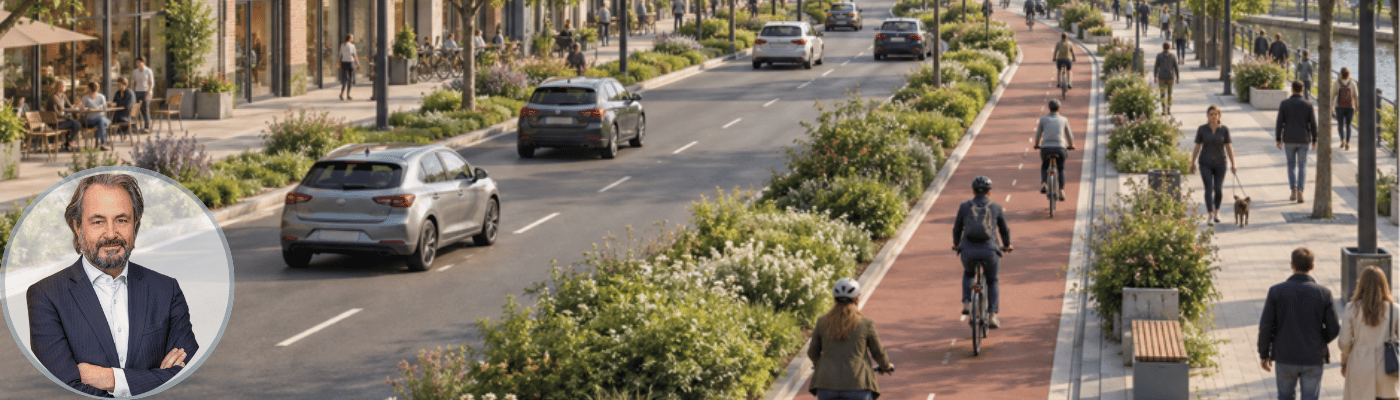
My concern is that we spend too much time hoping for fewer cars and too little time making our roads safe for the cars that are coming. An electric much safer car still occupies space. Cleaner propulsion does not remove congestion, and driver assistance does not make a badly designed junction safe. The revolution in vehicles therefore needs an equally serious transformation of their surroundings.
That gives transport professionals a concrete assignment. Build cycle tracks with physical protection. Design junctions so that an ordinary mistake does not become a fatal collision. Install appropriate median barriers and forgiving roadsides. Make safe speeds intuitive through road design. A safe system should accommodate human error, because even careful people occasionally misjudge a situation.
Use traffic management to keep through traffic on suitable routes and out of residential streets. Better detection and responsive signals can help manage conflicts and allocate space where it is needed. Managing parking can reduce unnecessary searching and keep pavements clear. Much of the work is practical, unglamorous and essential.
And take the visual presence of cars seriously. Concentrate parking, screen infrastructure and, where justified, put traffic or parking below ground. Giving people access by car need not mean allowing cars to dominate every public space. This requires choices about where driving belongs, how much space it receives and what users pay for scarce capacity.
These are precisely the kinds of challenges that have kept me involved in Intertraffic’s advisory board for already over fifteen years. What interests me is the connection between a technological possibility and a better street: how a detection system, a barrier or a smarter junction can improve everyday life.
Intertraffic matters because it brings those technologies together with the people who must make them work in practice. Vehicle innovation alone cannot deliver a safe and liveable transport system. That also takes road authorities, infrastructure designers and technology providers learning from one another. A promising product only fulfils its purpose when it works on an actual road, for actual people. That is where our industry can make a difference, through thousands of decisions about everyday infrastructure.
We can influence how much people drive, particularly in dense cities. But expecting the world to turn away from increasingly affordable, cleaner and safer individual mobility is wishful thinking.
The car is becoming harder to resist, and please don’t shoot the messenger. We better become smarter at living with it. Managing the consequences of growing car ownership, from pressure on public space to road safety, congestion and environmental impact, will be a defining task for the decades ahead. That is precisely what the Intertraffic community is here for. The cars will keep getting better. It is up to us to make sure the places they take us do too.
Share your story
Do you have an innovation, research results or an other interesting topic you would like to share with the professionals in the infrastructure, traffic management, safety, smart mobility and parking industry? The Intertraffic website and social media channels are a great platform to showcase your stories!
Please contact our Sr Brand Marketing Manager Carola Jansen-Young.
Are you an Intertraffic exhibitor?
Make sure you add your latest press releases to your Company Profile in the Exhibitor Portal for free exposure.
.png?h=400&iar=0&w=1400)
.png?h=628&iar=0&w=1200)
.png?h=400&iar=0&w=1400)
Get up to speed on the mobility industry - our newsletter straight to your inbox!