
.png?h=400&iar=0&w=1400)
We can't improve what we can't measure
Europe's transport data blind spot
Transport is becoming increasingly data-driven, but Europe still lacks sufficiently comparable and consistent data to understand how national transport systems are performing.
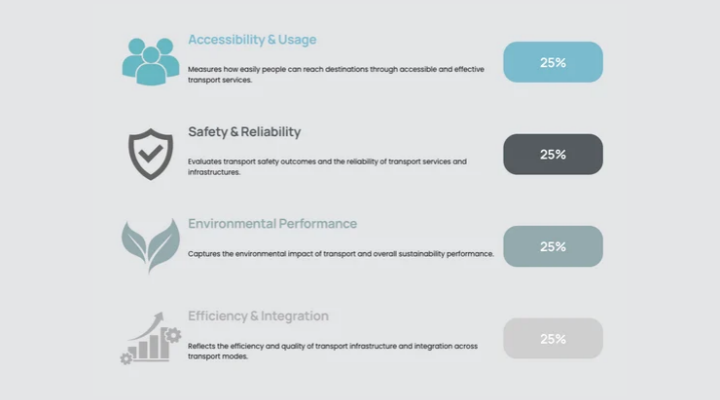
Developed by the Smart Transportation Alliance (STA), the Transport Sector Health Index (TSHI) compares national transport systems using 16 publicly available indicators across four dimensions: Accessibility & Usage, Safety & Reliability, Environmental Performance, and Efficiency & Integration.
The 2026 edition assessed 32 European countries, including the EU, EEA, Switzerland and the UK, but ranked only 24. Belgium, Cyprus, Iceland, Liechtenstein, Norway, Slovakia, Switzerland and the United Kingdom did not meet the minimum data-coverage threshold of three available indicators per dimension.

Source: Valentina Lung Illes
Safety emerges as a major data gap
Safety & Reliability is one of the four TSHI dimensions with the largest data gaps, affecting seven of the eight countries.
In Belgium and Slovakia, the missing indicators cover road fatalities and serious injuries per billion vehicle-kilometres. Cyprus lacks data on rail punctuality and reliability, while data on vulnerable road users and rail-service reliability were not publicly available for the UK, Switzerland, Norway and Iceland.
This highlights a deeper challenge: transport safety cannot be assessed simply by counting accidents or fatalities. Meaningful cross-country comparisons require consistently measured indicators that account for exposure to traffic, vehicle-kilometres travelled, and differences in how countries collect and report safety data.
The gaps extend beyond safety
Despite the EU’s efforts to decarbonise transport, environmental performance remains a challenge. The UK, Switzerland, Norway and Iceland did not meet the coverage requirements for the indicator on transport pollutant emissions per capita.
Other gaps concern accessibility and usage (including public transport use and affordability) as well as efficiency and integration indicators such as infrastructure quality, logistics performance and congestion.
Crucially, a country missing from the TSHI ranking should not be seen as performing poorly. It means that the available data do not provide sufficient coverage for a robust comparison within the same framework.

Europe has data, but is it comparable enough?
The issue is not necessarily a lack of transport data. Across Europe, countries collect detailed information on infrastructure, mobility, safety, emissions and operations to monitor resilience, network performance and sustainability. The challenge is whether this data is open, consistent, comparable and sufficient for cross-country assessment.
A country may maintain extensive records of its road and rail networks, passenger journeys, accidents or transport emissions, yet still lack data that can be aligned with other countries' reporting systems.
Infrastructure condition may be measured using different standards; mobility statistics may cover different journey types or transport modes; safety records may distinguish serious injuries and incidents in different ways; and emissions estimates may use different boundaries or calculation methods.
.png)
Data may also be held by separate public authorities, transport operators or private providers, limiting its accessibility for independent assessment.
Without comparable evidence, it is harder to identify underperforming systems and support planning, investment and the evaluation of national policies. This is particularly important when assessing transport health across countries with different network structures, geographical characteristics and patterns of cross-border travel. The absence of a comparable measure does not necessarily indicate that a transport system is performing poorly. It may instead reveal limitations in how performance is recorded, shared or measured against a common standard.
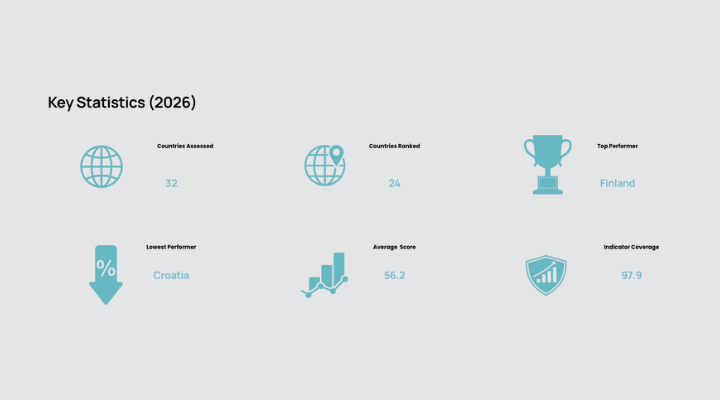
The gaps in the Transport Safety Health Index (TSHI) reveal more than the eight countries that could not be ranked: Europe still has blind spots in its understanding of transport-system performance. These gaps raise a wider question about whether countries are collecting the right information, using sufficiently consistent definitions and making it accessible for cross-border assessment. A transport system cannot be fully evaluated by the data available within national boundaries alone if the indicators used to assess its health cannot be compared across them.
For STA, identifying these gaps is central to the TSHI’s purpose. As the Index becomes an annual benchmark, improving data coverage may be as important as improving the infrastructure and services it measures.
Better data brings better visibility of transport performance, and better visibility is the foundation for better decisions.
Read more about the 2026 TSHI and its methodology.
Share your story
Do you have an innovation, research results or an other interesting topic you would like to share with the professionals in the infrastructure, traffic management, safety, smart mobility and parking industry? The Intertraffic website and social media channels are a great platform to showcase your stories!
Please contact our Sr Brand Marketing Manager Carola Jansen-Young.
Are you an Intertraffic exhibitor?
Make sure you add your latest press releases to your Company Profile in the Exhibitor Portal for free exposure.
.png?h=400&iar=0&w=1400)
.png?h=628&iar=0&w=1200)
.png?h=400&iar=0&w=1400)
Get up to speed on the mobility industry - our newsletter straight to your inbox!