

CROSS-BORDER LOGISTICS: FROM DATA TO ACTION TO REAL WORLD IMPACT
With the aim of simplifying cross-border logistics compliance the KEYSTONE Project’s Europe-wide partners created a fast lane for digitised transport logistics operations, turning compliance into an altogether smoother, faster and EU-compliant process.
The EU-funded KEYSTONE project has demonstrated how standardised digital data exchange can support more efficient, transparent and connected road freight operations. As the three-year, multi-partner project approaches its final destination, Intertraffic takes a look at what turning data into action actually means in the grand scheme of things - and in the digital road freight ecosystem in particular.
Road freight operators still face major bottlenecks due to fragmented systems, paper-based processes, and manual checks. All these challenges drive up costs and slow down operations, creating additional administrative burden.
One of the main characteristics of the KEYSTONE project is that it involved, from an early stage, both industry and governmental stakeholders with the sole purpose of creating a joint digital solution for logistics compliance. Together, they build on a future where compliance is no longer an obstacle but an integrated and largely automated part of transport operations.
"One of the key characteristics of the project is that it involved, from an early stage, both industry and governmental stakeholders to create a joint digital solution for logistics compliance"
Through its pilot activities, KEYSTONE tested how transport operators, ports, terminals and enforcement authorities can exchange information through standardised APIs, real-time ETA data and digital transport documents such as electronic consignment notes (eCMR).
Partnerships of KEYSTONE
Under the stewardship of 16 partners (including the Technical University of Madrid, TTS Italia, Smart Transportation Alliance (STA), Etelätär Innovation and Coventry University) from six countries (UK, Spain, Italy, Greece, Estonia and Belgium), the project included two pilot deployments.
Pilot 1 (P1) focused on a road transport setting based on a monomodal road transportation scenario with port interaction, in which a truck transports a container to the Port of La Spezia in Italy and port-related controls are carried out with support for automated ETA transmission and digital document handling in eCMR format.
Pilot 2 (P2) addressed an intermodal transport setting, combining rail and road operations along a chain from Rotterdam terminal to CIM Novara terminal, followed by a roadside inspection in Italy, with the aim of validating real-time data availability and compliance verification across the intermodal chain.
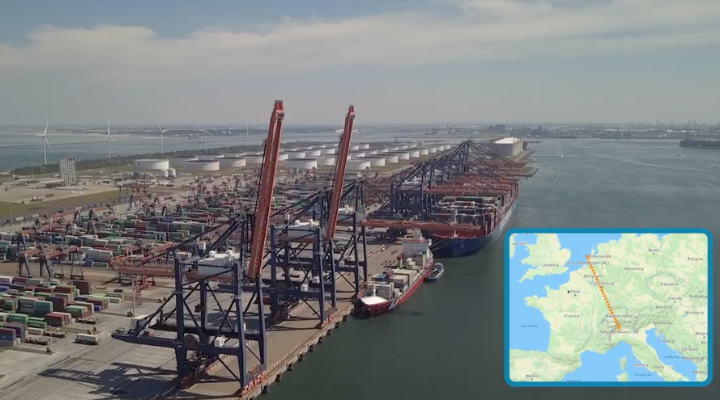
The pilots showed how road freight operations can move away from fragmented, paper-based processes towards a more connected digital ecosystem. For the road sector, the key achievement is that KEYSTONE proved that interoperability between private logistics systems and public authorities is possible in practical operating conditions. In the road transport pilot, the project supported digital information exchange in a road-port environment, helping to improve visibility of freight movements and support compliance-related checks.
BETTER CONNECTED
The future implication is a road ecosystem where hauliers, ports, logistics platforms and authorities are better connected through trusted digital interfaces. This could help reduce administrative burden, avoid unnecessary stops, improve coordination between road and port operations, and support smarter enforcement and compliance processes.
"The future implication is a road ecosystem where hauliers, ports, logistics platforms and authorities are better connected through trusted digital interfaces."
“KEYSTONE demonstrates that a digital road freight ecosystem is not only a future ambition, but something that can be tested and validated in real operating conditions. By enabling standardised data exchange between transport operators, ports and authorities, the project points towards a more efficient, interoperable and resilient road transport system,” says Jesús Martinez, CTO, of project partner Etelätär Innovation.
“KEYSTONE has moved digital road freight from concept towards practical demonstration, with scaling of this innovative approach across Europe’s roads, ports and logistics nodes the logical next step.
The project kicked off in June 2023 and concluded in May 2026 with a final event at TRA in Budapest.
COMPLIANCE IN PRACTICE
At its core, KEYSTONE’s aim was to streamline road freight transport processes by enabling fully digital compliance.
The KEYSTONE Web App showcases how this shift can happen in practice. Three tailored interfaces enable real-time data exchange between drivers, enforcement authorities, and port authorities, creating a seamless and reliable digital ecosystem. Validated across port and intermodal networks in Europe, it is proven that not only does it improve efficiency for logistics companies, but also supports more consistent and effective enforcement compliance across borders - something that is essential in a truly European transport market.
Looking ahead, the road freight ecosystem is undergoing a radical transformation as technical developments emerge, and digital solutions come into play. Road freight operations have already witnessed many changes due to the large expansion of e-commerce, the numerous sustainability incentives steering towards lower-emission practices and the emerging technological developments becoming integral to day-to-day operations.
"Validated across port and intermodal networks in Europe, it is proven that not only does it improve efficiency for logistics companies, but also supports more consistent and effective enforcement compliance across borders - something that is essential in a truly European transport market."
EU-funded initiatives such as KEYSTONE show how this future can be achieved: by connecting stakeholders, streamlining workflows, reducing delays and costs, and simplifying cross-border compliance procedures. More importantly, they underline a fundamental shift in the sector, where cooperation between industry and authorities is a necessity, and where digitisation acts as the driving force behind this transition to a more efficient, safe, and sustainable European logistics ecosystem.
“The challenge now lies in ensuring widespread market uptake and long-term adoption of the KEYSTONE Web App,” adds José F. Papí, CEO of Etelätär Innovation and STA President.
“KEYSTONE has already accelerated the digital transformation of logistics operations while highlighting the need for further fine-tuning, interoperability improvements, and stronger alignment between technological solutions, regulatory frameworks, and operational practices.”

.png?h=400&iar=0&w=1400)
.png?h=183&iar=0&w=290)
Get up to speed on the mobility industry - our newsletter straight to your inbox!