
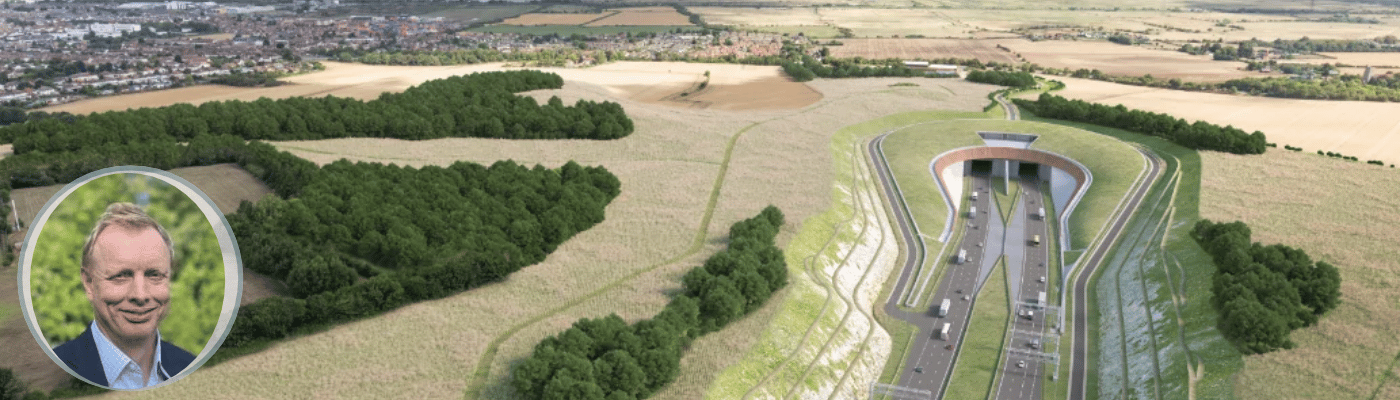
How to build a low-carbon road
While budget constraints have put many UK infrastructure projects on ice, the Lower Thames Crossing, the UK’s largest road-building project for decades, now has the green light and is blazing a trail for reducing carbon emissions in all types of construction. As the project progresses, we bring you an update on some of the principles that are evolving to guide it.
By: Tom Stone
The construction industry faces an uncomfortable truth. While overall emissions in the UK have fallen dramatically since 1990 – thanks to green energy sources such as wind farms helping to decarbonise the national grid – construction emissions are actually rising.
“While the national grid is 78% down, we’re actually going up,” says Matt Palmer, executive director of the Lower Thames Crossing. “That’s predominantly driven by volume. As an industry, we’re expending more carbon than ever before.”
This creates a fundamental clash. The UK is legally committed to reducing emissions by another 50% by 2040. Without radical change in how infrastructure is built, the construction sector risks becoming unsustainable.
However, a new flagship project: the Lower Thames Crossing – the UK’s largest road investment since the London orbital M25 – is positioning itself as the undertaking that will drive the industry toward net zero.
According to Palmer, carbon emissions from road building can be broken down into three main areas: steel, concrete and diesel. Each presents distinct challenges and opportunities. Steel for construction is one of the easiest to address.
“You can buy a low-carbon reinforcement bar right now – you just need to choose to do it,” says Palmer.
Plant steel is harder, but solutions are emerging. Volvo Construction Equipment announced at the start of 2025 that it is incorporating low-carbon steel into serial production of all its articulated haulers built at its major Braås facility in Sweden.
Concrete is more complex – “it’s a recipe,” says Palmer – but the industry is making significant strides. Palmer expects carbon-capture technology on cement works by 2028-2030 to deliver carbon-neutral or carbon-free cement. “Right now, we’re progressing towards that,” he says.
Then there’s diesel – construction’s hardest nut to crack.
“We’ve all spent 100 years getting really used to it. We build everything with it. Every year someone brings out a new piece of plant that’s bigger, better, uses more diesel, but actually helps us build things more efficiently,” Palmer observes. “Diesel is probably our hardest challenge.”
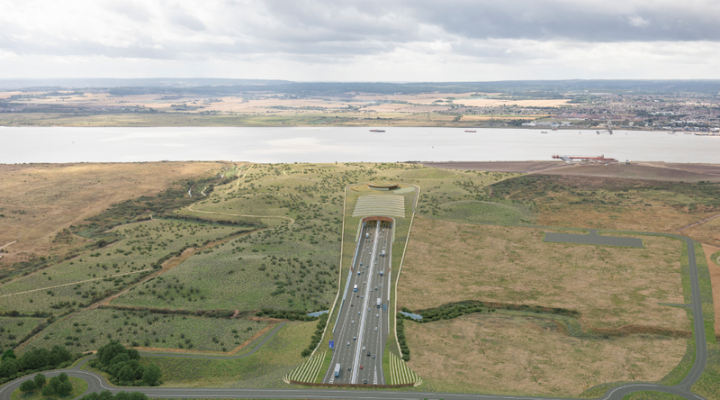
Five principles for change
National Highways has distilled four years of work into five fundamental principles, recognising that transformation requires collective action.
Thames Crossing; we can’t do this alone as National Highways; we have to do it as an industry,” says Palmer.
As well as being executive director for the Lower Thames Crossing’s Matt Palmer also serves as industry sponsor for net zero and biodiversity at the Construction Leadership Council. In this role, he helped develop the Five Client Carbon Commitments to help decarbonise construction in road building and beyond.
The programme has already secured commitments from major infrastructure operators including HS2, Anglian Water, Heathrow and Transport for London.
“There’s a deliberate reason for this. They all do roughly the same thing that LTC and National Highways do,” says Palmer. “We are trying to drive the whole infrastructure sector to decarbonise using those five principles.”
The Lower Thames Crossing is pioneering these commitments, which are described as “simple, practical steps that organisations can take to show how they are reducing their carbon emissions and by when.” They embed carbon commitments in procurement processes.
The first principle – which is easy to do but harder to realise – is embedding carbon into contracts.
“We’ve got three very big contracts with carbon targets in them,” Palmer explains. “It’s like any other part of a contract. They’re incentivised to deliver it and to beat it.”
This approach cascades from first-tier contractors down through the supply chain, which has the potential to change how the industry operates.
The second principle addresses fuel strategy with an ambitious timeline. By 2027, all Lower Thames Crossing construction sites will be zero emissions with no fossil or biofuels used on site. “We’ve got phase-out dates of when we will get rid of diesel – we’ll go emission free,” says Palmer. The project has already deployed the world’s first hydrogen-powered excavator for commercial use – a JCB machine that uses a hydrogen combustion engine.
The third principle tackles concrete standards. “Everybody needs to focus on this,” says Palmer.
The project uses 65% GGBS (ground granulated blast-furnace slag) as a cement replacement, significantly reducing the carbon footprint of concrete while maintaining structural performance.
Steel sourcing forms the fourth principle, focusing on maximising recycled content and selecting the lowest-carbon options. The project prioritises steel reuse and recycling for both temporary and permanent structural applications, while exploring substitutes like basalt and fibre in reinforced concrete.
The fifth commitment is rigorous monitoring and measurement using PAS 2080, which has been developed by the British Standards Institution to provide a framework for measuring, reporting and managing carbon from initial design through construction, operation and eventual end-of-life.
The Lower Thames Crossing is the first UK road project to receive PAS 2080 accreditation, meaning an independent body has verified that its carbon management systems meet this rigorous standard. It requires all parties in the supply chain – clients, designers, contractors and suppliers – to work together on continuous carbon reduction rather than oneoff calculations.
“It will be our Bible,” Palmer says of the carbon management framework.
Exceeding expectations
When the programme launched, Palmer’s team believed they could achieve a 30% carbon reduction “for free.” The market response exceeded all expectations.
“When we challenged our delivery partners, we ended up with a 50% reduction in the bid,” says Palmer.
Contractors including Skanska, Ferrovial and Sir Robert McAlpine are now committed to this ambitious target.
“They’re really challenged to deliver that 50%, but they’re committed and they’re doing it,” Palmer adds.
Nick Harris, chief executive of National Highways, describes the Lower Thames Crossing as vital to the organisation’s broader decarbonisation strategy.
“It’s an important pathfinding project, showing the way to do construction with much, much lower carbon emissions,” he says.
The government has since pushed even further. The Secretary of State challenged the team to achieve carbon neutrality – going as far as possible (estimated at 70% reduction) and offsetting the remainder.
“That is how aggressive this thing will be,” Palmer states.
Harris emphasises the collaborative nature of achieving the 70% reduction target: “They, together with the project team, shared their passion for getting the project done and, more importantly, for doing it as a pathfinder project to deliver a really low carbon footprint.”
Embodying the low-carbon ethos of the project, footbridges over the new Lower Thames Crossing roads will use a new design that utilises wood over steel. Traditional steel footbridges spanning 100m across multiple lanes are being replaced with glulam (glued laminated timber) structures that remove 80% of the carbon.
“The carbon will only really be in the foundations, because it’s light, the foundations are much less,” says Palmer.
While common in Scandinavia, this approach requires building UK supply chain capability.
“This is not inventing anything new.
This is just supersizing what we can do,” says Palmer.
We can’t do this alone as Lower Thames Crossing; we can’t do this alone as National Highways; we have to do it as an industry Matt Palmer, chief executive, Lower Thames Crossing
The Lower Thames Crossing’s ambitious decarbonssation programme offers a template for the industry, but its success depends on collective commitment across clients, contractors and supply chains. Palmer urges the industry to work together: “Come and join the fight to take carbon out of construction.”
Based on presentations at Highways UK, Birmingham, October 2025
Leading the carbon revolution
The Lower Thames Crossing has achieved several industry firsts in its pursuit of carbon neutrality:
■ First UK road project to receive PAS 2080 accreditation
■ First major infrastructure project with a legally binding carbon cap (1.445Mt CO2e)
■ Achieved Gold level accreditation from the Carbon Literacy Project
■ Pioneered the Five Client Carbon Commitments, now adopted by HS2, Anglian Water, Heathrow and TfL
■ World’s first deployment of hydrogen-powered excavator on a road construction site
■ By 2027: All construction sites will be zero emissions with no fossil or biofuels used
■ The project has reduced its carbon baseline from 2.76 million tonnes CO2e to a legally binding limit of 1.445 million tonnes – then set itself an even more ambitious target of 840,000 tonnes, representing a 70% reduction
Low-carbon haulers
Volvo Construction Equipment recently became the first vehicle manufacturer to implement low-carbon emission steel into serial production of its articulated haulers at its Braås facility in Sweden – exactly the kind of plant steel innovation identified as crucial for decarbonising the Lower Thames Crossing and other construction projects.
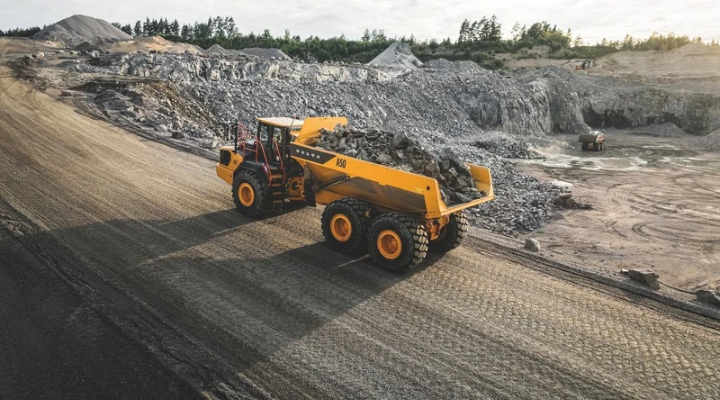
In Volvo’s articulated haulers, it accounts for 60% of total mass and over 50% of the machine’s carbon footprint. The Swedish steel revolution offers two pathways. Fossil-free steel, produced using iron ore with fossil-free electricity and biogas, has already been delivered to customers. Low-carbon emission steel, made from recycled steel using the same clean energy sources, is now entering mass production.
By replacing just 13% of conventional steel with the low-carbon alternative, Volvo is cutting over 13,000 tonnes of CO₂ annually from its production in Braås, Sweden.
“It is important to act to cut emissions in the production phase, including materials like steel, in close collaboration with our global supply partners,” says Rickard Alm, head of Volvo CE’s Life Cycle Assessment programme.
This article was first published in the 2026 edition of Intertraffic World Magazine.
Advertising & editorial opportunities
Want to be featured in the forthcoming 2027 edition? Explore advertising and editorial opportunities to put your organisation, expertise or solutions in front of the industry.
For more information, please contact Karen German.
Tel: +44 (0)1322 626961
Mobile: +44 (0)7939 286517



Get up to speed on the mobility industry - our newsletter straight to your inbox!