
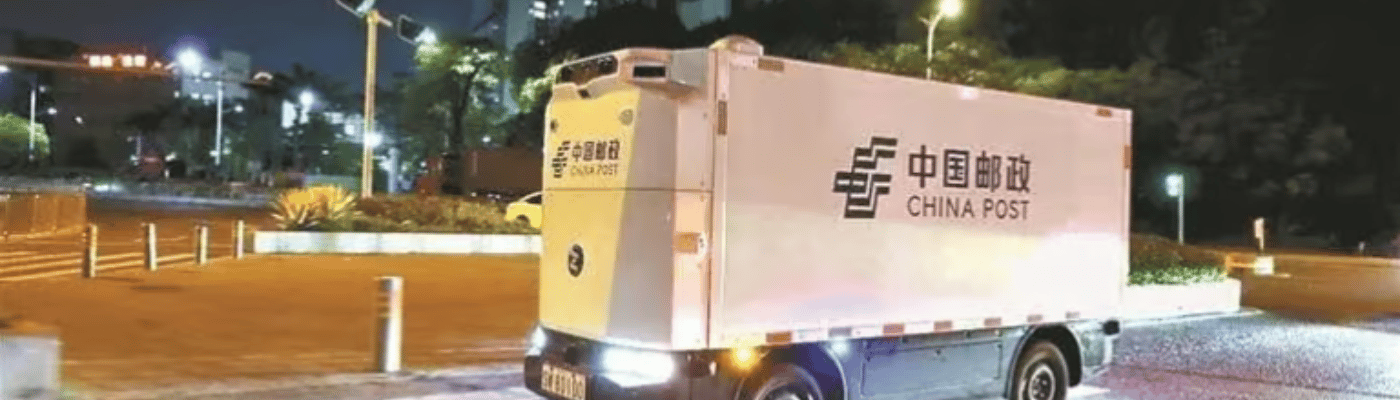
China's experiment in midnight metro logistics
China has chosen a different way of thinking about urban transport. Instead of treating passenger transport and freight as entirely separate activities, cities could coordinate them across different networks and different times of day.
As China's cities explore new ways to move goods through increasingly congested urban environments, the city of Shenzhen is demonstrating how metro infrastructure and autonomous delivery vehicles could help create a new layer of urban logistics.
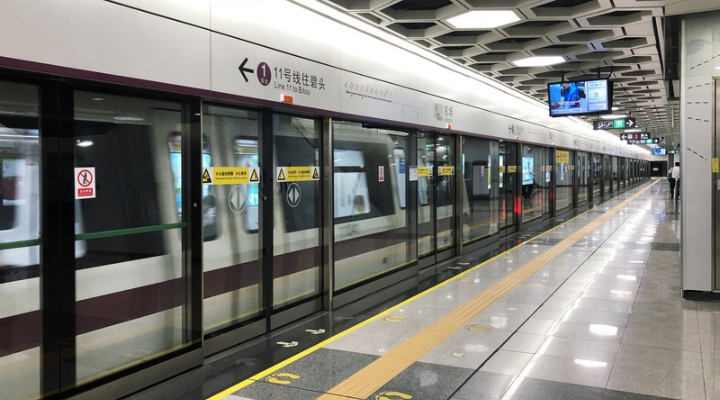
When the last passengers leave the platform and the final train pulls into the depot, a city's metro system enters a different phase of its working day. Tracks must be inspected, stations cleaned and equipment maintained before the morning rush begins. But in China, this otherwise quiet window is also attracting interest from another sector: urban logistics.
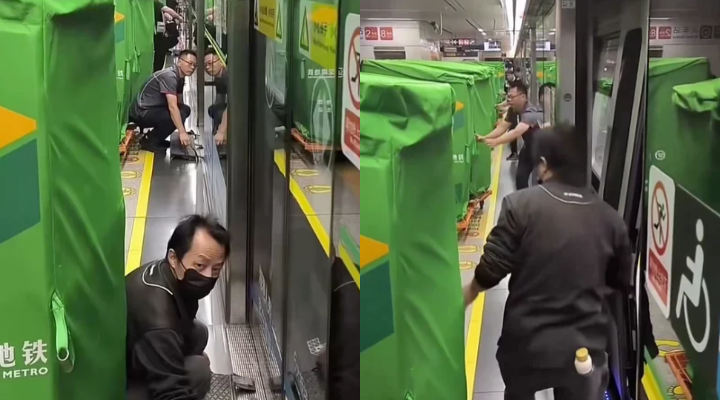
In Shenzhen, one of China's most technologically advanced cities located around 1900 kilometres south of Beijing, metro infrastructure is being explored as a means of transporting goods overnight. The principle is straightforward: use the railway network when passenger demand has ended, moving freight beneath the streets rather than adding more delivery vehicles to already busy roads.
It is an appealing proposition. Cities have invested enormous sums in their metro networks, yet their capacity to carry passengers is largely unused for several hours each night. Could some of that spare capacity also help meet the growing demand for urban deliveries?
Making the most of the night
The concept of night-time metro logistics is not unique to Shenzhen. Guangzhou piloted a night-time metro logistics service in 2022, while Shenzhen, a city with a population of over 18 million, subsequently developed its own approach to integrating rail transport with autonomous delivery technology. Other Chinese cities have also explored related models.
What makes the concept interesting is the potential to combine existing transport infrastructure with increasingly capable automation.
Rather than moving every parcel by road from a distribution centre to its destination, a logistics operator could use autonomous vehicles to collect or distribute goods at designated locations, with the metro providing the longer-distance link between urban districts.
In Shenzhen, research into autonomous delivery vehicles operating across metro lines and stations describes a system in which vehicles can navigate station environments and use adapted lift controls to access the railway. The ambition is to connect different parts of the transport network without requiring every stage of the journey to be handled manually.
The operating model nevertheless requires careful coordination. Goods must be loaded, transferred and unloaded within the available overnight window, while the railway operator retains time for inspection, cleaning and maintenance. Passenger services must resume safely and on schedule the following morning.
The metro is therefore not simply a ready-made freight railway waiting to be switched on. Its potential depends on how effectively logistics operations can be integrated into an existing passenger transport environment.

Underground rail meets autonomous delivery
The metro initiative is also part of a wider development in Shenzhen: the rapid expansion of autonomous delivery on the city's streets.
Driverless logistics vehicles can undertake repetitive journeys between warehouses, distribution points and delivery destinations. Operating at night can offer advantages where road traffic is lighter, although vehicle utilisation, loading arrangements and access to delivery locations remain important considerations.
In March 2026, Shenzhen formally opened night-time road access to functional autonomous vehicles, creating new opportunities for driverless logistics operators to move goods between distribution centres and delivery hubs during off-peak hours. The policy has helped accelerate a shift from limited trials towards more routine commercial operations.
According to figures reported by the Shenzhen municipal government in July, the city's night-time autonomous delivery network expanded from just two routes to 331 in the three months following the policy change. More than 100 vehicles had been deployed, while night-time driving mileage exceeded 40,000 kilometres in June alone. These figures point to a substantial expansion in the use of autonomous vehicles for overnight freight movements.
The growth is not simply a matter of putting more vehicles on the road. It also reflects a change in how the city organises its logistics capacity.
According to Shenzhen's transport authorities, autonomous logistics operators use a dynamic dispatch system that adjusts the number of vehicles in service to match demand. At peak periods, approximately 30% of the fleet is online, compared with around 15% during typical daily operations. Intelligent scheduling helps match available vehicles to demand across different time slots, improving fleet utilisation while controlling operating costs.
This approach allows logistics companies to use their assets more flexibly. Vehicles can undertake daytime delivery work and then support overnight replenishment or transfers between warehouses, reducing the need to dedicate separate fleets to different parts of the working day.
courtesy Hola Fujian/X
A growing network of autonomy
The city's wider autonomous vehicle network is also expanding rapidly. Data from the Shenzhen Intelligent Connected Transportation Association showed that at the end of May 2026, more than 20% of functional autonomous vehicles' total operating mileage was being accumulated at night. The city had 1,273 functional autonomous vehicles in operation: 815 logistics vehicles, 453 sanitation vehicles and five inspection vehicles. It had also opened 2,633 logistics routes, with a combined length of 11,980 kilometres.
These figures describe the broader functional autonomous vehicle network, rather than the night-time delivery fleet alone. Nevertheless, they illustrate the scale of the infrastructure and operational ecosystem developing around autonomous urban services.
The distinction between this road-based expansion and the metro freight initiative remains important. The two approaches are complementary in principle, but the available figures do not establish that Shenzhen's metro and autonomous road networks already operate as one fully integrated logistics system.
In a potential integrated model, autonomous road vehicles could handle the first and final stages of a delivery, while metro services carry goods between designated transfer points. Such an arrangement could reduce the need for individual road vehicles to make longer cross-city journeys.
The extent to which this model can be implemented commercially will depend on the availability of suitable transfer facilities, coordination between operators and the economics of moving goods through multiple transport modes.
Nevertheless, the underlying idea is significant. Urban freight does not necessarily have to follow the same routes, schedules or operating patterns as passenger transport. With suitable planning, a city could use different parts of its infrastructure at different times of day.
Turning night into a logistics advantage
Shenzhen's expansion of autonomous night deliveries is also an experiment in urban traffic management.
During the day, roads must accommodate commuters, public transport, commercial traffic and delivery vehicles competing for limited space. At night, some of that road capacity becomes less heavily used, even as warehouses and retailers continue to require regular supplies of goods.
Moving logistics activity into these quieter periods offers a way to make better use of existing infrastructure without necessarily increasing road capacity.
Shenzhen's authorities argue that night-time autonomous delivery can help preserve valuable daytime road space for commuters while improving freight efficiency. Rather than treating the night as an idle period, the city is using it to move goods between distribution facilities and prepare supplies for subsequent daytime deliveries.
The operating pattern can be particularly useful for warehouse replenishment, cross-district transfers, parcel distribution and the delivery of fresh food and other everyday goods. These activities do not always need to coincide with the hours when most people are travelling.
The approach also depends on effective management. Not every vehicle needs to operate continuously, and putting an entire fleet on the road would risk increasing costs without delivering corresponding benefits. Flexible dispatch allows operators to maintain sufficient capacity for busy periods while limiting unnecessary vehicle movements when demand is lower.
There are, however, practical considerations. Night-time operations require suitable lighting, vehicle visibility, noise management and reliable responses to incidents. Autonomous vehicles must also be monitored, and operators need clear procedures for dealing with mechanical faults, road obstructions and unexpected delays.
Shenzhen's emerging regulatory framework reflects these concerns, with an emphasis on safety requirements, clearly assigned responsibilities and the monitoring of vehicle operations. The challenge is to expand commercial activity without allowing rapid growth to outpace the systems needed to manage it.
The operational challenge
The apparent simplicity of using the metro after the last train conceals several practical challenges.
First, there is the question of capacity. Passenger trains, stations and platforms are designed around particular patterns of demand. Freight operations introduce different requirements for loading space, goods handling, security and transfers. Operators must establish whether the available time and space can accommodate commercially meaningful volumes.
Second, the railway's overnight maintenance window cannot be treated as spare capacity in its entirety. Track inspections, engineering work, cleaning and equipment checks remain essential. Any freight service must fit around these activities without compromising safety or the reliability of the morning passenger timetable.
Automation creates further questions. Vehicles need to navigate stations reliably, interact with lifts and other infrastructure, and move between different transport environments. A workable system must also address exceptions: damaged goods, vehicle faults, delayed transfers and unexpected restrictions on station access.
The road-based network faces its own operational tests. A rapidly expanding route network requires effective vehicle supervision, consistent maintenance, dependable communications and clear procedures for responding to incidents. As the number of operating vehicles grows, authorities must also ensure that traffic rules and safety requirements are applied consistently.
Finally, there is the commercial case. Rail transport might reduce the road distance travelled by delivery vehicles, but goods still need to be collected, transferred and distributed. The benefits will depend on freight volumes, handling costs, labour requirements, energy consumption and the locations of participating logistics facilities.
The same applies to autonomous road delivery. High route numbers and rising mileage demonstrate operational expansion, but they do not automatically establish profitability or environmental gains. Evidence on cost per delivery, vehicle utilisation, energy consumption and the number of conventional journeys displaced will be needed to assess the full benefits.
For transport authorities and operators elsewhere, these are the questions that will determine whether the model can be replicated beyond a limited pilot.
A new role for urban transport infrastructure?
The broader significance of China's night-time logistics experiments lies in their approach to infrastructure utilisation.
Cities commonly plan passenger transport and freight distribution as separate systems, even though both compete for space, energy and access to the urban environment. Metro-based logistics offers a way to reconsider that separation, using the railway as a potential component of a wider urban freight network.
Shenzhen's progress in autonomous delivery adds another dimension to this idea. The city is developing a system in which logistics operations can be distributed across different vehicles, routes and time periods, with automation helping to coordinate the movement of goods.
Its intelligent connected vehicle industry is one of the city's strategic emerging sectors. Shenzhen has also been at the forefront of China's regulatory development in this field, becoming the first city in the country to introduce dedicated local legislation for intelligent connected vehicles. Its subsequent expansion of road access and commercial trials for autonomous delivery reflects an effort to turn technological development into routine urban services.
The significance extends beyond the vehicles themselves. Successful autonomous logistics requires cooperation among vehicle manufacturers, delivery companies, warehouse operators, infrastructure providers and public authorities. It also requires systems for dispatch, monitoring, maintenance and incident management. The result is an emerging logistics ecosystem, rather than simply a collection of driverless machines.
One size may not fit all
The approach will not suit every city. Metro systems differ in their overnight operating arrangements, station layouts, maintenance requirements and proximity to logistics hubs. Some may have little practical capacity for freight without substantial modifications. Others could offer useful connections between major distribution points, particularly where road congestion makes cross-city deliveries difficult.
The environmental case also needs to be demonstrated rather than assumed. Moving goods by rail could reduce road traffic, while autonomous vehicles operating at night could improve the use of existing road capacity. But the overall benefit depends on how many conventional journeys are displaced, the energy consumed by the new system and the additional handling involved.
For Shenzhen, the next test is likely to be whether these experiments can deliver reliable, measurable and commercially viable services at scale. Evidence on freight volumes, delivery times, costs and reductions in road vehicle kilometres would help establish the model's wider value.
For the international transport community, however, the question is already worth asking. As cities seek to accommodate growing delivery demand without continually expanding road capacity, could the infrastructure they have already built play a greater role in moving goods?
In China's night-time metro logistics experiments, the answer being explored is that urban transport need not stop working when the passengers go home. Alongside an expanding fleet of autonomous delivery vehicles, the hours between the last train and the first could become another part of the city's logistics day, provided the technology, infrastructure and economics can be made to work together.
Share your story
Do you have an innovation, research results or an other interesting topic you would like to share with the professionals in the infrastructure, traffic management, safety, smart mobility and parking industry? The Intertraffic website and social media channels are a great platform to showcase your stories!
Please contact our Sr Brand Marketing Manager Carola Jansen-Young.
Are you an Intertraffic exhibitor?
Make sure you add your latest press releases to your Company Profile in the Exhibitor Portal for free exposure.


Get up to speed on the mobility industry - our newsletter straight to your inbox!