
.png?h=400&iar=0&w=1400)
Grow your own fuel: the age of green hydrogen
British hydrogen innovator GeoPura recently announced that they had been named as the supplier of the largest volume of green hydrogen ever produced for a particularly notable British construction project.
National Highways’ £11bn (€13bn) Lower Thames Crossing, what will be the country’s longest road tunnel that will join the counties of Kent and Essex either side of the river, will be the first major British infrastructure project to be carbon neutral in construction. A key part of the ambition is replacing diesel with hydrogen, electric and other low-carbon fuels. Unlike diesel, hydrogen only emits water when used in a fuel cell, dramatically reducing greenhouse gas emissions and protecting air quality for both the workforce and local communities.
CLEAN ENERGY’S CLEAR ADVANTAGE
Enhancing hydrogen production capacity is a key part of the Government’s plans to increase energy security by reducing reliance on imported fuel sources that are vulnerable to disruption in supply. The emerging green energy sector has the potential to create over 400,000 jobs and add over £7 billion (€9bn) to the British economy by the Lower Thames Crossing’s estimated completion date of 2031.
The UK’s Minister for Industry, Chris McDonald, said:
“GeoPura and the Lower Thames Crossing collaboration is proof that clean energy goes hand-in-hand with major British infrastructure projects.”
So there’s an obvious question that needs to be answered: Who are GeoPura and, other than green hydrogen-powered infrastructure project support, what else do they bring to the renewable energy table?
The Newcastle-upon-Tyne based company’s Chief Hydrogen Business Officer Matthew Barney takes up the story.
“Geopura was established back in 2019 but since then, along with our collaboration partner Siemens Energy, we've been building and manufacturing hydrogen power units. These are, in the simplest terms, a diesel generator replacement. They actually do a lot more than a diesel generator, but they run on hydrogen. So we utilize green hydrogen through a hydrogen fuel cell system, and it enables us to provide power at any place, any time, at any scale, and regardless of whether you've got some grid power available or no grid power available to meet whatever power requirement you might have for any purpose. And all of this on an entirely zero emission basis.”
The use of green hydrogen means that this is a 100% end-to-end zero emission process.
“We're also making that hydrogen at scale across a number of sites here in the UK, and that hydrogen is taken to our customer sites. And we're absolutely delighted to have recently won a contract with Lower Thames crossing, which is a £9bn (€10.4bn) project and the Government is really looking to champion this as being one of the greenest and most sustainable construction projects of this scale anywhere on Earth.
“We're absolutely delighted to have recently won a contract with Lower Thames crossing, which is a £9bn (€10.4bn) project and the Government is really looking to champion this as being one of the greenest and most sustainable construction projects of this scale anywhere on Earth.”
“We're thrilled that in order to achieve that, they've supported this with a hydrogen supply contract. We’ll be supplying a significant quantity of hydrogen over a five-year period, which will be made available to the three contractors who have also been selected on the site to actually do the construction work. This is genuinely exciting for the hydrogen supply sector. We also hope that, in due course, we’ll be able to supply them with some hydrogen power units and to support the actual construction project itself.”
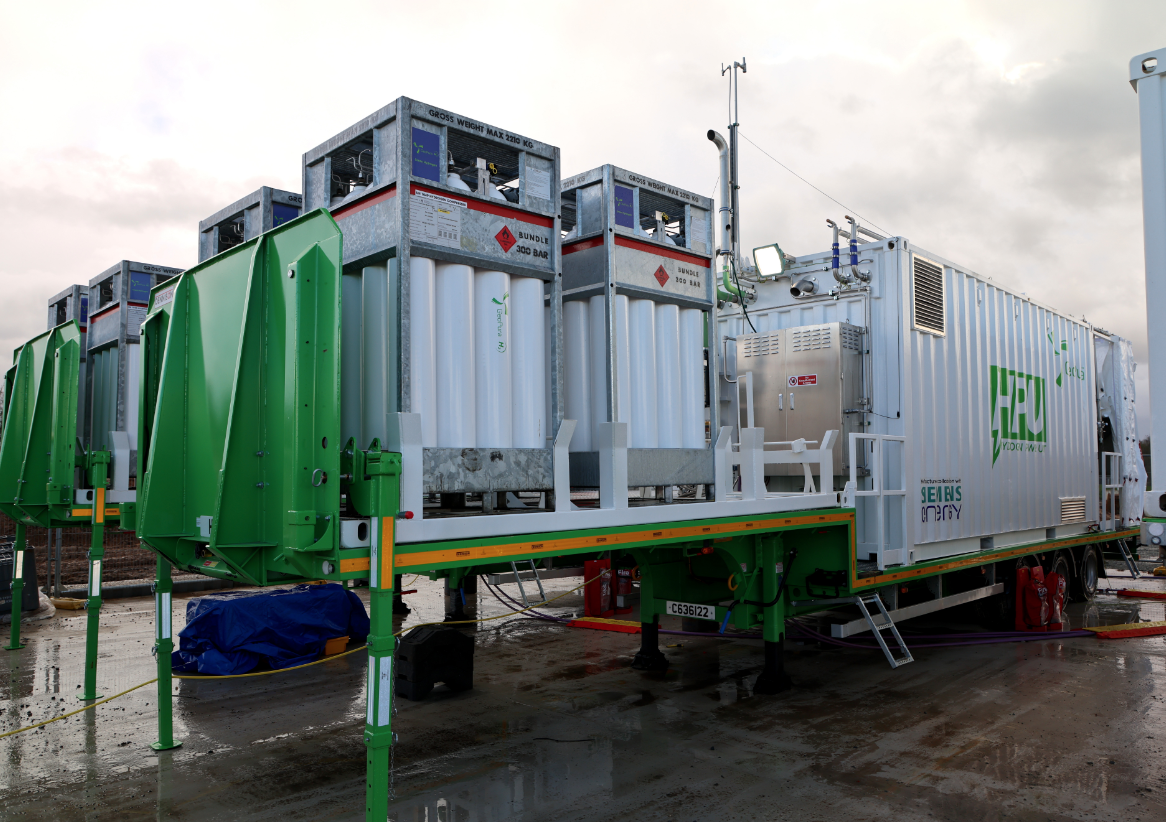
A GeoPura hydrogen-powered generator at the Lower Thames Crossing site by GeoPura
PLANTING THE SEED
The first thing you think about (potentially) when considering the use of hydrogen in a project the size of the Lower Thames Crossing, is the use of renewable-powered plant, such as diesel generators, but Barney’s thinking is far broader than that.
“You absolutely can use hydrogen power units to displace diesel generators, but this contract is much wider than that. So not only are we looking to displace diesel generators with hydrogen power units, but also to fuel other construction equipment. So, plant equipment, excavators, scale excavators, lifting equipment, all sorts of different elements of construction equipment, which there's now a hydrogen alternative to the old diesel, diesel equivalents that you can buy using hydrogen. Our hydrogen will be used for all of those purposes. But as well as that, we'll be using it to support the charging of battery electric equipment as well, so battery electric vehicles, but also battery electric plant. It’s really exciting already to see on the construction site. We're only at the preliminary works stage at the moment, but some of the first battery electric equipment of its kind is now arriving on site, and green hydrogen is being used to get those electrons into those batteries.”
“We're only at the preliminary works stage at the moment, but some of the first battery electric equipment of its kind is now arriving on site, and green hydrogen is being used to get those electrons into those batteries.”
WE SHALL OVERCOM
In terms of challenges, what does Matthew Barney see as the biggest hurdle to overcome to convince organisations such as National Highways or local authorities to use renewable power, hydrogen in particular, and how does he deal with the “we haven't done it like that before” conundrum that is regularly faced by anyone bringing something new into the equation?
“I think there's been a couple of core challenges historically to using hydrogen,” he begins. “One is the infrastructure hasn't been there. So even though hydrogen is the most common element in the universe, it’s more about having it in a usable form and providing that on a sustainable, zero emission basis. The infrastructure hasn't been there. Over the last six or seven years, we've been building that infrastructure at scale, and it's reached the point where we're producing across four sites.
“As for the logistics and getting hydrogen from A to B, all the necessary equipment hasn't been there. It now is, and it's there at scale. So that's a huge drive. And one of the issues with there not having been hydrogen, of course, is there's manufacturers wanting to produce equipment that can use hydrogen and battery electric, but the grid hasn't been there to support battery electric, or if hydrogen supply hasn't been there to power your excavator, that's been a problem. So it's that chicken and egg thing. You need to have the fuel to supply the plant, and if you don't have the fuel, then obviously the plant can't be powered. We've overcome that and this is why this is so exciting.”
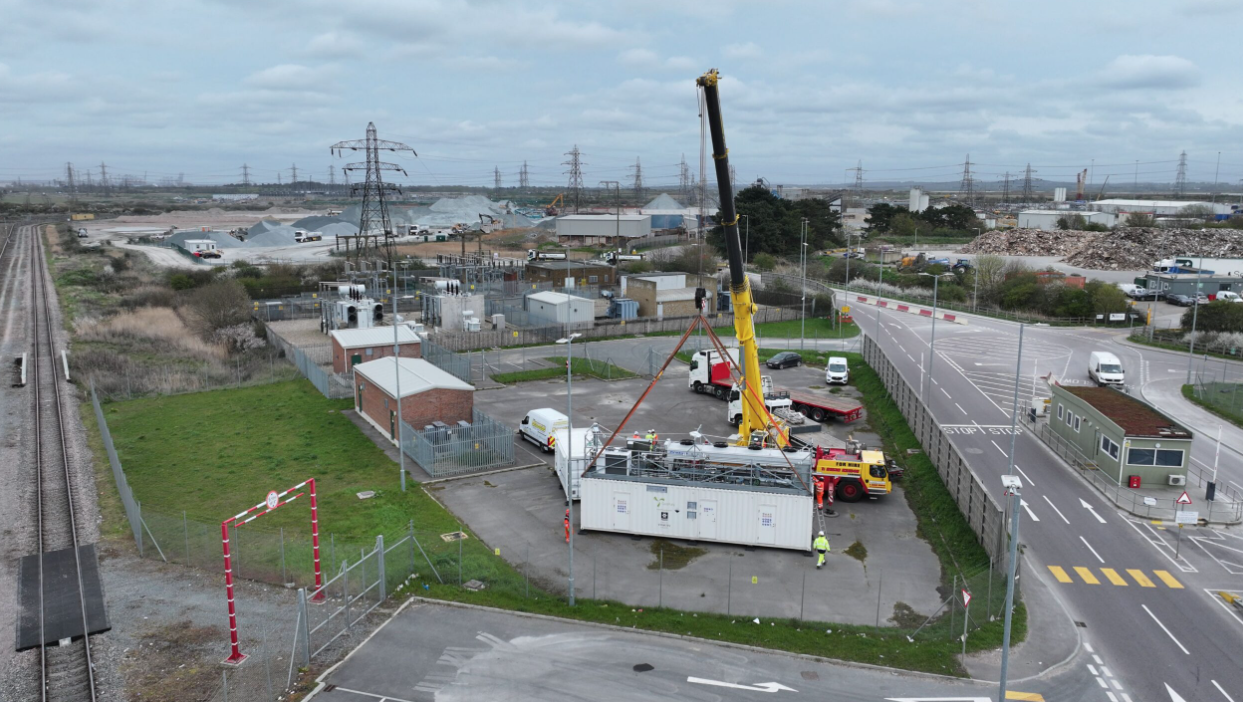
Green hydrogen production at the Port of Tilburyt in Essex by GeoPura
PERFECTING THE MESSAGE
The final piece of the jigsaw, as Barney alludes to, is in the realm of hearts and minds - encouraging people to use equipment that they had perhaps not used before. It’s all part of the transitional process.
“Over the last few years we've been involved in lots of construction projects right across the UK, and it's been fantastic to work with companies who initially, had reservations and asked if hydrogen was safe to use and would it work. At the end of the day, am I going to be able to do what I could do with diesel generators? In every case, you discover quite quickly when you start to use this stuff, it is really safe, it's really clean, and people like it. So again, I'm really excited about what the Lower Thames Crossing contract might lead to in the UK and Europe.”
“Over the last few years we've been involved in lots of construction projects right across the UK, and it's been fantastic to work with companies who initially, had reservations and asked if hydrogen was safe to use and would it work.”
The popular perception of the use of renewable energy and alternative fuel in terms of the European market is that countries such as France and Germany are probably further ahead than the UK in where they rank environmental friendliness in their project goals. Firstly, is that a fair assessment and secondly how do GeoPura go about making an impact in the European market?
“From day one, we have seen that our market was not just a European one, but global,” he says, adding that the company have recently opened an office in Denmark. “These technologies really have a place to displace diesel across the world at a time when there's fuel security issues increasing at the moment. These are tense times for oil production so with the supply of that being in question, once again, you have to consider the benefits of having alternative methods to grow your own fuel and have a zero-emission alternative and something that's more reliable.”
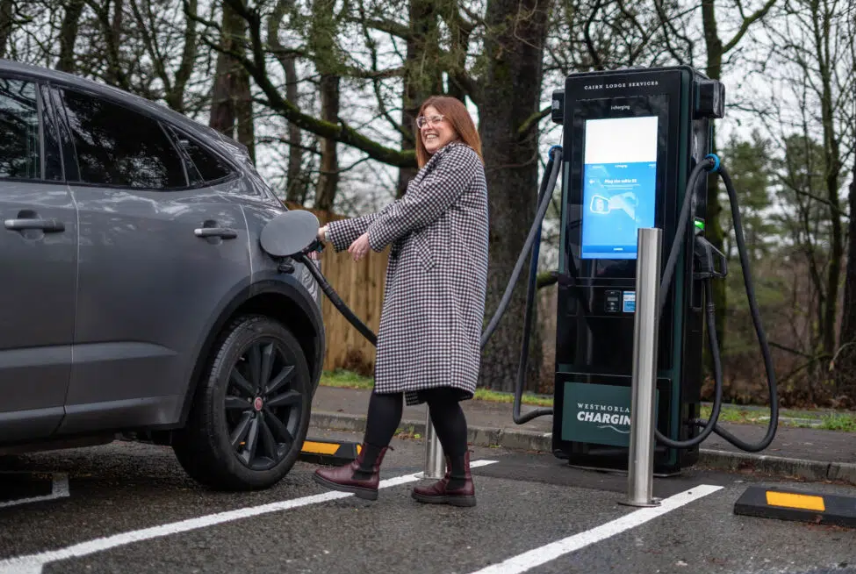
Green hydrogen-powered EV charge point by GeoPura
A BATTERY ELECTRIC FUTURE
Finally, where does Matthew Barney see the renewable energy sector in five years’ time? The market has grown exponentially over the last few years – perhaps a decade ago you would struggle to find an article on sustainable fuel in a traffic technology-based trade publication, but that is certainly not the case now. What discussion would Intertraffic and GeoPura be having in April 2031?
“I think we're going to continue to see the great rollout of battery electrics. I drive a battery electric vehicle. Absolutely love it. I never want to go back. It feels quite strange when I inadvertently end up in somebody's petrol car. I have to go to a petrol station, and it feels quite antiquated,” he says with a degree of incredulity.
“Hydrogen has a key role to play in supporting that. So again, going back to that issue of grid supply, we do a lot of work supporting service stations and grid networks where that there's just not enough electrons at the local level. At the national level it’s actually pretty good. But at local level, getting that supply, getting that copper, getting enough infrastructure to do what we all like to, which is charge very quickly, it creates a degree of difficulty. Whether that's in the short term or the longer term, hydrogen has a huge role to play in that. You're able to put a hydrogen power unit in along whatever bridge it might have, and then, on a commercial basis, provide charging at any scale. Again, working with large scale companies, working construction, a lot of our work is supporting EV charging of both vehicles and equipment. I think for HGVs, for buses, for trains, for transport in general, hydrogen has an absolutely key role to play, just because of the power to weight ratio. Batteries are heavy.
“There comes a point where it's difficult to get enough charge for the weight you're carrying around to have the dual duty cycles of what you might want operating 24/7,” he concludes. “With hydrogen you can refuel, and so those barriers are removed, and you get that same energy impact, that same energy density that you'd get from a fossil fuel, and all those benefits… but with no carbon.”
Share your story
Do you have an innovation, research results or an other interesting topic you would like to share with the professionals in the infrastructure, traffic management, safety, smart mobility and parking industry? The Intertraffic website and social media channels are a great platform to showcase your stories!
Please contact our Sr Brand Marketing Manager Carola Jansen-Young.
Are you an Intertraffic exhibitor?
Make sure you add your latest press releases to your Company Profile in the Exhibitor Portal for free exposure.


Get up to speed on the mobility industry - our newsletter straight to your inbox!