
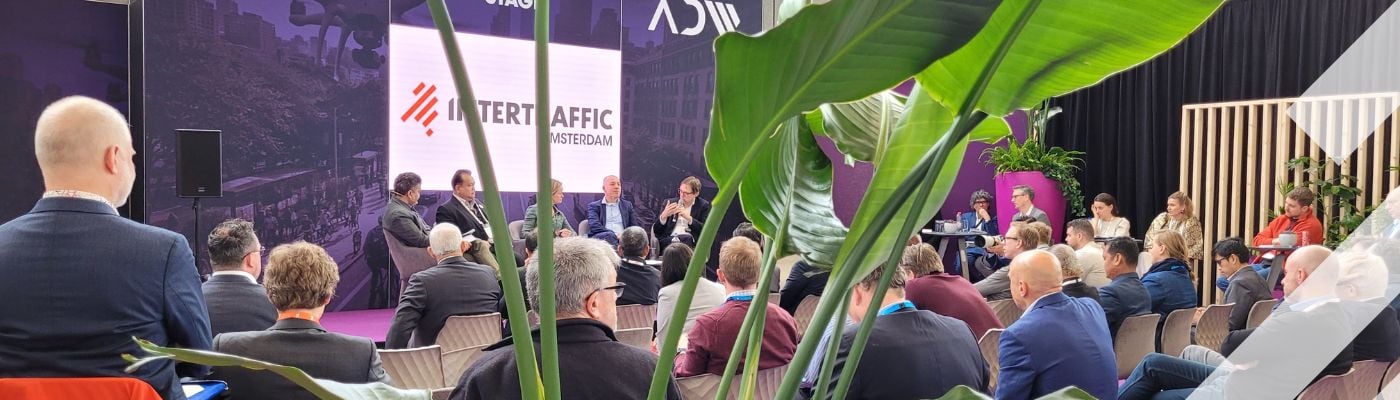
Leave no-one behind: why resilience is key to meeting the challenges of the growing demand for mobility
The rising demand for mobility, for both people and goods, can no longer be met by adding infrastructure or new transport modes, said the session’s preamble. So, how do we keep cities and regions accessible in a growing mobility landscape?
The Next Mobility Stage in Hall 11 was the place to find out, Space constraints, sustainability goals and the need to protect urban liveability require a more integrated and holistic approach. This session, with speakers from the European Commission, Dutch Ministry of Infrastructure and Water Managemen, Polis, Cities Today Institute and the Malaysian Ministry of Works, explored how solutions ranging from smarter urban planning and behavioural change to innovative and sustainable mobility concepts, including the use of air mobility as a third dimension, can help maintain accessibility and connectivity now and in the future.
DG Dutch Ministry of Infrastructure and Water Management's Kees van der Burg used the year of the first Intertraffic Amsterdam, 1972, as a reference point, charting the progress of the concept of shared mobility and how data now plays so much more of a role than it did back in the year of the last moon landing. The Dutch Government’s Mobility Vision 2050, he explained, sets out how mobility acts as an enabler to healthcare, education and employment, ensuring that transport links are accessible to all.
Dato Sri Alexander Nanta Linggi, the Malaysian Works Minister, talked of how the growing mobility landscape in his country is presenting challenges and opportunities, citing next year’s first Intertraffic Asia, taking place in Bangkok in April, as a case in point – that South East Asia is a region that has embraced everything that smart mobility has to offer to keep its cities running but that the transport of people and goods by road and rail is still of paramount importance.
Polis Secretary General Karen Vancluysen maintained that access to essential services and the protection of the environment and the economy are the key drivers behind meeting the growing demand for mobility. No one should be left behind, she insisted, as cities and regions look to address the challenges of congestion and pollution
Eric von Breska, Director of the European Commission’s DG Mobility and Transport, highlighted the importance of best practice exchange between cities and regions across Europe, pointing to the success of Sustainable Urban Mobility Plans (SUMPs) as an example of how at least this continent has adopted the right approach. Public transport, he maintained, is, or at least should be, the backbone of a city’s accessibility plans and goals, offering a sustainable and affordable gateway to mobility, keeping cities, and their inhabitants, moving.
Resilience, sharing, flexibility, inclusivity, planning, listening and acting – a combination of all of these “must-haves” are how cities can meet their mobility challenges head-on, while ensuring their public transport networks run smoothly, efficiently and sustainably.
Share your story
Do you have an innovation, research results or an other interesting topic you would like to share with the professionals in the infrastructure, traffic management, safety, smart mobility and parking industry? The Intertraffic website and social media channels are a great platform to showcase your stories!
Please contact our Sr Brand Marketing Manager Carola Jansen-Young.
Are you an Intertraffic exhibitor?
Make sure you add your latest press releases to your Company Profile in the Exhibitor Portal for free exposure.


Get up to speed on the mobility industry - our newsletter straight to your inbox!