
Global ambitions, real results: the state of autonomous vehicle deployment
Summit Theatre 3 was the venue for the great and the good of the AV sector, with MapTM stalwart Tom Alkim moderating a panel of experts from Nissan, Holo, Wayve, Uber and WeRide (via Espace Mobilités) who discussed the current state of autonomous vehicle deployment. The discussion centred upon the notion of moving from global ambitions to real-world implementation, and what is needed to scale up in practice.
Holo’s Christian Zinckernagel majored on his company’s AV vision, namely piloting the transition from traditional mobility to autonomous mobility, with the day’s recurring themes of AI, data, safety and compliance at the forefront of the Danes’ thinking. The tech is ready, he insisted, it’s a matter of deciding how to deploy it safely and wisely.
Uber’s Pierre Delalande agreed with Zinckernagel on the subject of the tech being ready, but suggested that public acceptance was crucial, admitting that the company had somewhat “forced themselves” on cities in the past, a mistake they were certain not to repeat. “We must talk with cities,” he maintained. “Not at them.”
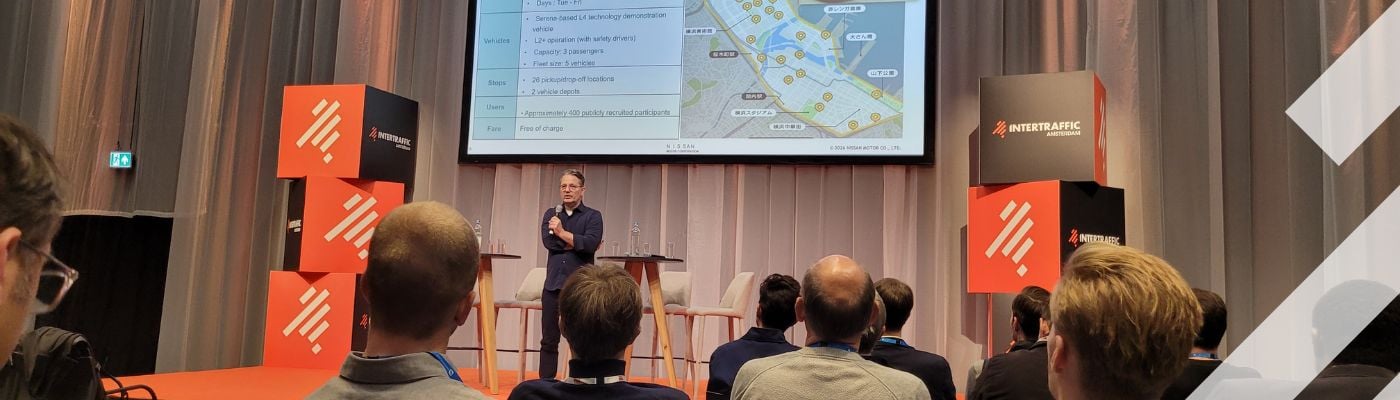
An excellent session all told, but undoubtedly the star of the show was Nissan North America’s Maarten Sierhuis, director of the car maker’s Advanced Technology Center in Silicon Valley, California. The always engaging Dutchman (one of the guests on a forthcoming episode of the Inside Intertraffic podcast) explained how Nissan’s Easy Ride project in Japan has given members of the public an all-important insight into the benefits of autonomous vehicle, echoing his Holo colleague’s view about the importance of public acceptance.
Two projects in Tokyo and Yokohama saw Nissan build Level 4 automated mobility ecosystems (although L4 is strictly still not allowed under Japanese law) through collaboration with partner companies. In the case of Yokohama, where the project operated under the banner of TOURISM x AUTOMATED MOBILITY (in Tokyo it was DAILY LIFE x AUTOMATED MOBILITY) the AV was a driverless tourist bus that run four days a week for 10 weeks, ending on 30 January. The vehicles were based on the Nissan Serena people carrier and featured 26 PUDO (pickup and drop-off) locations and two vehicle depots. Around 400 publicly recruited participants took part in the Yokohama trial alone, with the circuit encircling the city’s most popular tourist sites.
If automated vehicle deployment, trials at least, are to become common sighs on our highways, then projects such as Easy Ride, with the backing of automotive giants such as Nissan, have to be considered as one of the most practical, and engaging, ways of moving forward.
Share your story
Do you have an innovation, research results or an other interesting topic you would like to share with the professionals in the infrastructure, traffic management, safety, smart mobility and parking industry? The Intertraffic website and social media channels are a great platform to showcase your stories!
Please contact our Sr Brand Marketing Manager Carola Jansen-Young.
Are you an Intertraffic exhibitor?
Make sure you add your latest press releases to your Company Profile in the Exhibitor Portal for free exposure.

Here we go – drummers,a robot and three massive balloons get Intertraffic Amsterdam 2026 off to a flying start
11 March 2026

A new approach to old beliefs: Monotch and BMW publish hard-hitting C-ITS whitepaper
18 March 2026
Leave no-one behind: why resilience is key to meeting the challenges of the growing demand for mobility
12 March 2026
Get up to speed on the mobility industry - our newsletter straight to your inbox!