
Can Connected Automated Vehicles be part of the public transport chain?
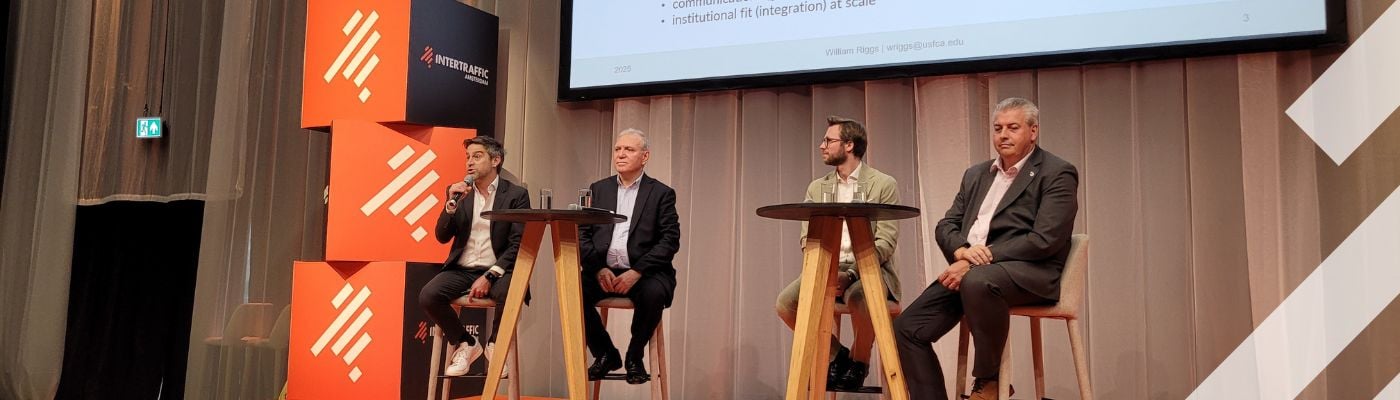
When the title of an Intertraffic Summit Programme session is a question, it can prove impossible to resist the temptation of answering it. However, the answer is not a simple ‘yes’ or ‘no’ on the evidence of this panel’s assertions. The answer is: no, it NEEDS to be.
Moderated with his usual brand of unbridled enthusiasm by the University of San Francisco’s Prof Billy Riggs, NMS-Hamburg’s Tim Johannes, Glydways’ Chris Riley and ADASTEC CEO Ali Ihsan Danisman discussed strategic programme management, deployment, practicalities and novel solutions by way of finding individual answers to the session title’s leading question but collectively they came to the same conclusion: CAVs have to be part of the modern day, smart public transport chain, from first- and last-mile solutions to flexible, demand-driven services. No ifs, no buts.
ADASTEC’s Danisman encapsulated his company’s approach to what has, at least in the past, been something of a thorny issue, with a short film, shot from the front seat perspective, that showed his driverless buses successfully navigating their way around a variety of different real-life scenarios in Sweden, Norway and the US, coming to a halt perfectly when seemingly mindless pedestrians seemed to test its capabilities by stepping out in front of it and walking as slowly as possible.
Johannes gave the audience as detailed an insight into the inner workings of Hamburg’s automated-driving ready public transport system as was feasible in in his allotted time, but it was his assertion that CAVs need to be part of a city’s public transport system that captured the spirit of the session.
Chris Riley’s presentation on Glydways’ potentially game-changing solution was something of an eye opener. The San Francisco-based Brit made the room sit up and take notice with its hypnotic loop video of a fleet of electric, autonomous, bidirectional, guided shuttles, with the message being that access to mobility is access to opportunity. Despite needing their own “guideways” complete with stations, Riley insisted that construction would cost 10-15% less, comparatively, than building an underground metro line. It’s hard to imagine too many European cities having wide enough streets to incorporate a Glydways guideway but in the US the City of Atlanta, GA is set to get trials underway later this year.
If the idea behind the Summit is to educate, inform and entertain (where have we heard that before?), then for this session, at least, it’s mission accomplished.
Share your story
Do you have an innovation, research results or an other interesting topic you would like to share with the professionals in the infrastructure, traffic management, safety, smart mobility and parking industry? The Intertraffic website and social media channels are a great platform to showcase your stories!
Please contact our Sr Brand Marketing Manager Carola Jansen-Young.
Are you an Intertraffic exhibitor?
Make sure you add your latest press releases to your Company Profile in the Exhibitor Portal for free exposure.

Here we go – drummers,a robot and three massive balloons get Intertraffic Amsterdam 2026 off to a flying start
11 March 2026
A new approach to old beliefs: Monotch and BMW publish hard-hitting C-ITS whitepaper
18 March 2026
Leave no-one behind: why resilience is key to meeting the challenges of the growing demand for mobility
12 March 2026
Get up to speed on the mobility industry - our newsletter straight to your inbox!