
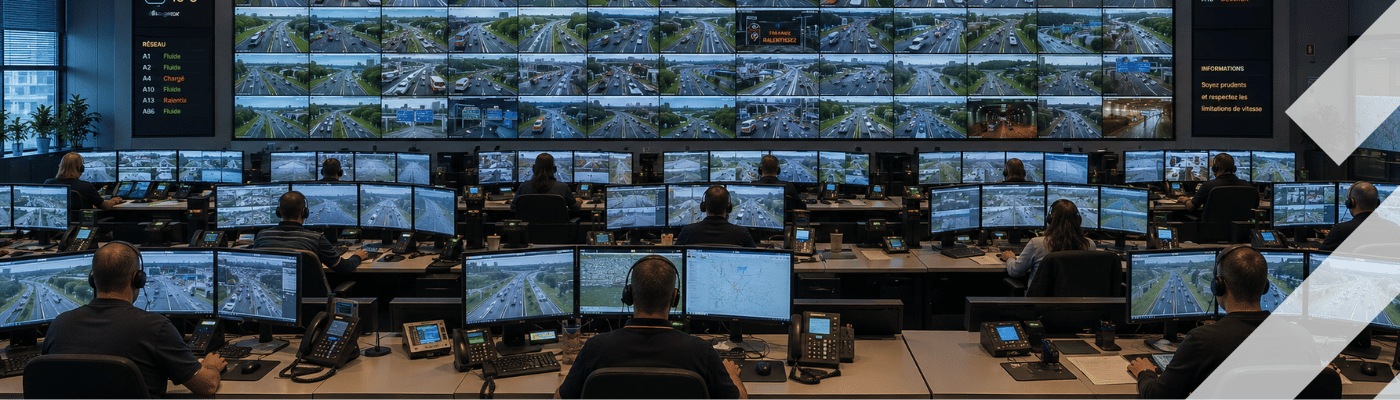
Why traffic management will always need humans
AI is coming for the routine jobs in traffic management centres - or so everyone seems to believe. But when the unexpected happens, people still matter more than machines
Spend any time reading the transport press these days and you'll quickly encounter a familiar narrative. Artificial intelligence is set to revolutionise road traffic management. Traffic management centres will become increasingly automated. Incident detection will soon be instantaneous. Signal timings will adapt automatically. Congestion will be predicted before it occurs. Operators will move from active management to passive oversight. Much of this is undoubtedly true.
The technology already exists to automate many of the routine, repetitive tasks that currently occupy traffic operators. Cameras can identify stopped vehicles, queues and incidents. AI systems can suggest diversion routes, calculate signal plans and generate reports in seconds. Machine learning can spot patterns in traffic data that would take a human analyst days to uncover.
For local authorities and highway agencies facing budget pressures, the appeal is obvious. Why employ teams of people to monitor hundreds of cameras when software can do much of the watching?
"For local authorities and highway agencies facing budget pressures, the appeal of AI is obvious. Why employ teams of people to monitor hundreds of cameras when software can do much of the watching?"
Yet there is another side to this story that receives considerably less attention.
While AI will undoubtedly transform traffic management, there are some roles and disciplines where humans are not simply useful, they are entirely indispensable. In fact, the more sophisticated our transport networks become, the more valuable certain uniquely human skills may prove to be.
The future of traffic management is not humans versus machines. It is humans and machines working together.
THE PROBLEM WITH PREDICTING THE UNEXPECTED
Where artificial intelligence excels is in recognising patterns. Give it enough historical data and it can become remarkably good at forecasting traffic demand, predicting congestion hotspots and identifying incidents. It thrives on repetition and consistency. The problem, of course, is that roads (and the people that drive on them) rarely behave consistently.
Ask any experienced traffic operator about the most challenging shift they've ever worked and they probably won't mention a routine motorway collision or a predictable rush-hour queue. They'll talk about the bizarre situations that no training manual could fully anticipate.
"AI thrives on repetition and consistency. The problem, of course, is that roads (and the people that drive on them) rarely behave consistently."
A burst water main that floods a key junction during the school run. A trailer full of pigs overturning on a major route. A power failure that knocks out dozens of traffic signals simultaneously. A sporting event overrunning and releasing thousands of spectators into a city centre at exactly the wrong time.
These are the situations where road networks become messy, complex and almost entirely human.
An AI-powered system may identify the problem quickly. It may even recommend an appropriate response, but deciding how best to balance competing priorities, communicate with partner agencies and manage public expectations often requires judgement rather than calculation - and it’s judgement that remains one of humanity's strongest advantages over technology.
THE ART OF DECISION-MAKING
Traffic management is frequently portrayed as a technical discipline. In reality, it is often a people discipline disguised as a technical one. Consider a serious incident on a strategic route.
Closing the road may seem obvious. But for how long? Which diversion routes should be used? Should local communities be protected from rat-running? What happens if the diversion route itself becomes congested? How should emergency services, local authorities, public transport operators and media organisations be informed?
None of these questions has a perfect answer.
Experienced operators draw on years of practical knowledge, local understanding and professional intuition. They know which residential roads will struggle with diverted traffic. They understand the political sensitivities surrounding particular routes. They can anticipate how local drivers are likely to react. These decisions are rarely based solely on data. They are based on context. And context remains extraordinarily difficult for machines to replicate. A machine will learn to choose what appears to be the best, most practical and most logical solution - but sometimes, it just isn’t what’s needed.
"Experienced operators draw on years of practical knowledge, local understanding and professional intuition. They can anticipate how local drivers are likely to react. These decisions are rarely based solely on data. They are based on context"
STAKEHOLDER MANAGEMENT CANNOT BE AUTOMATED
One area where human involvement is likely to remain essential is stakeholder coordination. Traffic management does not happen in isolation. A modern road network involves local authorities, highway authorities, emergency services, public transport operators, utility companies, event organisers, freight operators and countless others.
When a major disruption occurs, success often depends less on technology and more on communication.
Who needs to know what?
Who has decision-making authority?
Which organisation is responsible for implementing a particular response?
These conversations frequently involve negotiation, persuasion and compromise. An AI system can distribute information. It can generate emails. It can summarise reports. What it cannot easily do is build trust.
Trust is accumulated through relationships developed over months and years. It comes from understanding personalities, organisational cultures and political realities. Every experienced network manager knows that solving a traffic problem often means solving a human problem first.
PUBLIC COMMUNICATION STILL NEEDS A HUMAN VOICE
It’s also true to say that drivers are surprisingly forgiving when they understand what’s happening. They become far less forgiving when they feel ignored.
This is why public communication remains such an important part of traffic management.
"Every experienced network manager knows that solving a traffic problem often means solving a human problem first."
During major incidents, road users want information, reassurance and transparency. They want to know what has happened, how long disruption may last and what alternatives are available. AI-generated messages can certainly help deliver information more quickly. Many organisations already use automated systems to populate websites, social media feeds and variable message signs.
But the most effective communication often requires empathy. People recognise when a message feels genuine and when it feels robotic.
A carefully judged statement from an experienced communications officer can calm frustration, manage expectations and maintain public confidence in a way that automated messaging struggles to achieve.
Technology can provide the words. Humans provide the tone. Once AI learns to develop empathy… who knows where that will lead us.
NETWORK PLANNING REQUIRES IMAGINATION
Another discipline that is unlikely to become fully automated is strategic traffic planning which is ultimately about imagining futures that do not yet exist. So how will a new development affect travel demand?
What happens if working patterns change?
How might autonomous vehicles alter behaviour?
Will people embrace new forms of mobility?
These questions cannot be answered solely by analysing historical data because, by definition, the future has not happened yet. Good planners combine evidence with creativity. They explore possibilities, challenge assumptions and ask awkward questions. Machines are excellent at extrapolating trends. Humans are often better at imagining ‘discontinuities’ - something that transport history is full of.
ETHICS, ACCOUNTABILITY AND RESPONSIBILITY
Perhaps the strongest argument for retaining human oversight concerns accountability. Imagine an AI-driven traffic management system makes a decision that contributes to a serious safety issue.
Who is responsible - the software developer? The highway authority? The operator who approved the recommendation?
"Perhaps the strongest argument for retaining human oversight concerns accountability. If an AI-driven traffic management system makes a decision that contributes to a serious safety issue, who is responsible?"
The answer becomes complicated very quickly. Society generally expects important decisions affecting public safety to have human accountability attached to them.
This principle already exists in aviation, healthcare and many other safety-critical sectors and road traffic management is no different.
AI may increasingly provide recommendations, but there will remain a strong expectation that suitably trained professionals retain ultimate responsibility for significant operational decisions. Someone who has seen this situation before - and maybe got it wrong the first time but got it spot-on the second, third and fourth times it occurred over a period of 16 years. That responsibility cannot simply be delegated to an algorithm.
EXPERIENCE IS STILL A SUPERPOWER
One of the most underrated assets in any traffic management centre is institutional knowledge. Every network has quirks. Every city has locations that behave differently from what the models predict.
Every region has seasonal patterns, local events and historical lessons that exist largely in the memories of experienced professionals. Ask a veteran operator why a particular junction struggles after a football match or why a diversion route should never be used during school collection times, and you may receive an answer that doesn’t appear in any database.
This accumulated experience remains incredibly valuable.
"Every region has seasonal patterns, local events and historical lessons that exist largely in the memories of experienced professionals. Ask a veteran operator why a particular junction struggles after a football match and you may receive an answer that doesn’t appear in any database."
Indeed, as AI systems become more prevalent, experienced professionals may become even more important because they will be needed to validate, challenge and refine automated recommendations. The best operators of the future may not be those who compete with AI. They may be those who know when not to trust it.
A PARTNERSHIP, NOT A TAKEOVER
The most realistic vision of the future is not one in which humans disappear from traffic management centres, leaving banks of autonomously operated video screens and an empty kitchen. Instead, it is one in which technology removes routine tasks and allows people to focus on higher-value activities.
AI will monitor more cameras than any human team could manage. It will process vast quantities of data in real time. It will identify patterns, suggest interventions and automate administrative work. That is good news.
But when networks become disrupted, stakeholders need coordinating, difficult decisions require judgement, and the public needs reassurance, people will still be at the centre of the process.
For all the excitement surrounding artificial intelligence, road traffic management remains fundamentally about managing human movement through human environments and as long as roads are used by people, there will be situations that require human understanding, human empathy and human responsibility.
The future traffic management centre may look very different from today's. It may contain more screens, more algorithms and far fewer repetitive tasks. But one thing is unlikely to change. When the truly unexpected happens, everyone will still look for Mark or Ellen to make the call.
"The future traffic management centre may look very different from today's, but when the truly unexpected happens, everyone will still look for Mark or Ellen to make the call."
There's also a slightly broader irony in the current discussion around AI in traffic management. Many of the aforementioned press articles focus on the tasks that can be automated because they're visible and measurable: incident detection, report writing, signal optimisation, CCTV monitoring. The things that resist automation tend to be the less tangible aspects of the job: judgement, persuasion, relationship-building, local knowledge, political awareness and accountability. Those are precisely the skills that experienced practitioners often regard as the most important parts of their role.
In other words, AI is very good at replacing the parts of the job that look like work from the outside. Where it is much less good is in replacing the parts that actually make the difference.
Share your story
Do you have an innovation, research results or an other interesting topic you would like to share with the professionals in the infrastructure, traffic management, safety, smart mobility and parking industry? The Intertraffic website and social media channels are a great platform to showcase your stories!
Please contact our Sr Brand Marketing Manager Carola Jansen-Young.
Are you an Intertraffic exhibitor?
Make sure you add your latest press releases to your Company Profile in the Exhibitor Portal for free exposure.
.png?h=183&iar=0&w=290)
.png?h=183&iar=0&w=290)
Get up to speed on the mobility industry - our newsletter straight to your inbox!