

Enhancing Dynamic Lane Management with C-ITS: how I2V technologies improve traffic management efficiency
Dynamic Lane Management has proven to be an effective and pragmatic solution for increasing motorway capacity where physical expansion is not feasible. Its performance, however, depends strongly on how clearly and consistently information is conveyed to drivers. On a heavily trafficked section of the A4 Torino–Trieste motorway, the integration of Cooperative Intelligent Transport Systems (C-ITS) is showing how Vehicle-to-Infrastructure technologies can enhance an already established dynamic lane solution, reinforcing its operational benefits and preparing it for future mobility scenarios.
Implemented on the Autostrade per l’Italia network, the project demonstrates how in-vehicle communication complements existing Intelligent Transport Systems, improving driver awareness and acceptance of road operators’ recommendations regarding driving behavior. C-ITS acts as a technological upgrade, extending the reach and effectiveness of Dynamic Lane Management.
A high-demand corridor calling for smarter use of infrastructure
The A4 Torino-Trieste motorway crosses one of Italy’s main industrial areas and carries traffic volumes of up to 200,000 vehicles per day, with a significant proportion of heavy goods vehicles. In this context, increasing capacity through conventional widening is constrained by space, environmental considerations and the need to align with urban-renewal objectives.
To address these challenges, Movyon developed and deployed a Dynamic Lane Management system that allows the emergency lane to be temporarily opened or closed to traffic when demand peaks or disruptions occur. The approach focuses on making more efficient use of existing infrastructure, increasing capacity only when and where it is needed, and under strictly controlled safety conditions.
Data-driven control of the dynamic lane
The Dynamic Lane Management system is supported by an advanced technological platform integrated in the road operator traffic control centre. A network of radars, laser scanners and AI-enabled cameras continuously monitors traffic conditions, analyses vehicle flows and forecasts congestion trends.
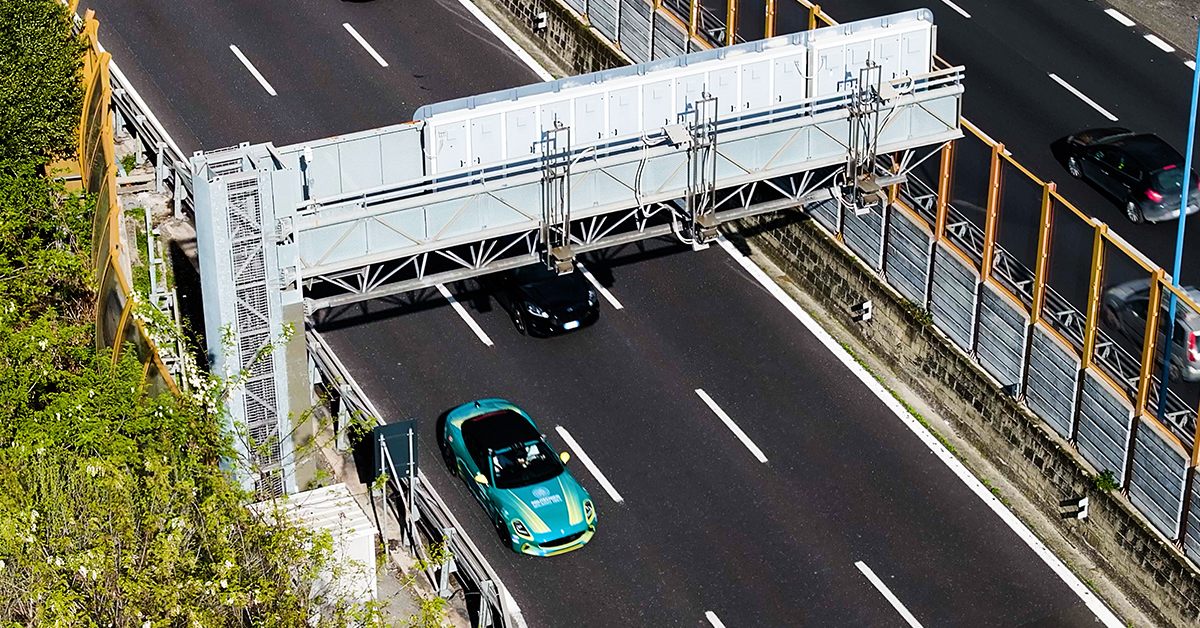
When predefined thresholds are met, the system enables the opening of the emergency lane and communicates lane availability and speed limits to drivers via Variable Message Signs (VMS) installed along the motorway. Automatic Incident Detection technologies simultaneously identify critical events and send alerts to the central system, allowing the immediate closure of lanes whenever safety requirements demand it.
Even in this configuration, the system delivers measurable benefits. Along the section, each hour of activation of the fourth dynamic lane is estimated to save around 1.5 tonnes of CO₂, thanks to smoother traffic flow and reduced congestion.
(Source: Movyon)
Strengthening Dynamic Lane Management through C-ITS
While roadside signage remains a cornerstone of Dynamic Lane Management, its effectiveness relies on drivers noticing, understanding and trusting the information provided. This is where C-ITS offers a significant enhancement. According to the literature, direct in-vehicle communication through In-Vehicle Information Messages (IVIMs) can improve drivers’ comprehension of the dynamic lane status by around 16% compared to roadside-only information.
To assess this contribution, Movyon has reconstructed the A4 motorway section in a detailed microsimulation model, incorporating all elements of the Dynamic Lane Management system. Real traffic data were used to evaluate performance across different penetration scenarios of connected vehicles and Infrastructure-to-Vehicle (I2V) communication’s adoption.
In parallel, experimental campaigns analysed ITS-G5 signal propagation along urban motorway sections, supporting the definition of the optimal layout for C-ITS roadside units enabling an effective data exchange. An in-vehicle message was also designed in line with European standards, replicating the information displayed on Variable Message Signs inside the vehicle.
Quantifying the benefits of connectivity and automation
The results of the simulations confirm that C-ITS significantly enhances the performance of Dynamic Lane Management. Automated emergency lane control supported by VMS alone already reduces peak-hour travel times by up to 2.4 minutes. When C-ITS is added in a fully connected vehicle scenario, congestion impacts are reduced by up to 12%.
Further efficiency gains emerge when higher levels of automation are introduced. In scenarios including connected and automated vehicles with platooning capabilities, overall efficiency improves by up to 18%, reducing peak-hour journey times by an additional minute compared to scenarios without autonomous vehicles.
The simulations furthermore show that, even with only 20% of vehicles being connected, a “pull-through” effect leads to overall compliance with traffic rules by 70% of vehicles, both connected and non-connected, thereby enhancing the effectiveness of the infrastructure and further reducing travel times along the A4 stretch by 7% during peak traffic hours.
Enhancing today’s motorways, enabling tomorrow’s mobility
The experience on the A4 Torino–Trieste motorway highlights the role of C-ITS as a strategic enhancement of existing traffic management solutions. By extending Dynamic Lane Management from roadside infrastructure into the vehicle, C-ITS strengthens safety, improves traffic efficiency and increases user acceptance, without requiring additional physical infrastructure.
As Europe moves towards interoperable connected mobility, the integration of C-ITS with Dynamic Lane Management represents a concrete step towards smarter and more sustainable motorways, capable of delivering immediate benefits while laying the groundwork for future connected and automated transport systems.
Share your story
Do you have an innovation, research results or an other interesting topic you would like to share with the professionals in the infrastructure, traffic management, safety, smart mobility and parking industry? The Intertraffic website and social media channels are a great platform to showcase your stories!
Please contact our Sr Brand Marketing Manager Carola Jansen-Young.
Are you an Intertraffic exhibitor?
Make sure you add your latest press releases to your Company Profile in the Exhibitor Portal for free exposure.



Get up to speed on the mobility industry - our newsletter straight to your inbox!