
BABY STEPS… FROM PILOT TO DEPLOYMENT THE NORDIC WAY
In a Summit Programme packed with intriguing sessions and presentations, one of the most enticing will see a panel of experts discussing the wider, pan-European deployment of Nordic+ ITS innovations. ITS Norway’s Chief Operating Officer, Jenny Simonsen provides a unique insight into the inspiration behind the topic
For anyone intrigued by the notion of scalability in the ITS sector, there’s only one place you need to be on Wednesday, 12 March. Intertraffic Amsterdam – Summit Theatre 1 – 1045 hrs. A half hour session entitled “From pilots to deployment: Scaling Nordic+ ITS Solutions across Europe” will show delegates what levels of cross-continental scalability is possible.
“The session is about the transition from pilot project to deployment,” says Jenny Simonsen, ITS Norway’s COO.
“It's about scalability, and how we build European competitiveness, as that is really the goal. From a European perspective, we won't go into the geopolitical situation, but it will be in the background because we've done a lot of testing. We've done a lot of great projects, but we missed the financing, and the scalability. So how do we do that? We will go back a little bit to look at the projects. What has been done in the Nordic region? Is there something that could be taught to the rest of Europe? What can we learn as well, and how do we build that European framework?”
OVERCOMING OBSTACLES
What are the barriers to the widespread implementation of such projects? Are Nordic barriers the same as those affecting the sector in the UK or in the Netherlands? Or are we talking geographic or topographic specifics? Jenny Simonsen turns the tables on Intertraffic.
"Are Nordic barriers to deployment the same as those that would be affecting the sector in the UK or in the Netherlands?"
“Let me ask you a question. What would you see as being the biggest barrier for scalability from, let's say, an automated vehicle project?”
Number one is obviously going to be cost. Number two is political will, and you need to have the innovative technology aligned with the political forward thinking to make sure those things happen, and thirdly, it’s public perception – the message is really key. How did we do?
“That’s a really good point,” she says. “It’s a case of what came first, the chicken or the egg, but related to ITS! I believe that the political ambition is particularly important because if you have a political ambition, you can start from the top. Look at the UK with its new automated driving law. Even King Charles III said that it's about the economy – that’s the message. It was worded in an interesting way because they put industry first, and then assuming that traffic safety is actually something that will come out of this, whereas we in the Nordics we were a little bit more cautious and focusing more on solving sustainability issues.
"I would like Nordic politicians to be as bold as the politicians in the UK and openly put the economy first"
She continues: “Whereas I would like them to be as bold as the politicians in the UK and put the economy first. Because if you put the economy first, you start with innovation. It's easier to innovate because the industry knows that the politicians are ambitious. We can work with the public and get new concepts out.”
NOTHING CHANGES/EVERYTHING CHANGES
So much has changed in the ITS and traffic management sector, and yet so little actually has.
In the early 20-teens, to have an idea for a European Commission transport research project, it had to save time, save money, save lives, or save fuel, ideally all four, and that is still evidently the case midway into the 2020s. Simonsen concurs.
“Exactly. But think about the driver shortage in Europe – in terms of public transport, 50% of the cost is the driver. So, down the line, we will need to automate the task of driving, but how do we then drive people towards shared public transport or robotaxis? Otherwise, we end up increasing traffic instead of reducing it.”
COOPERATE AND COEXIST
As for the session itself, in addition to ITS Norway, there will be presentations from Finland, Latvia and Estonia. As for potential takeaways, what does Jenny see as the message delegates can relay on their return to work on Monday, 16 March?
“I’d say that what we want to achieve with this session is also the cooperation part, which is lacking. It’s not just talking about the need to cooperate more; we need to coexist more. We need to do something. And then the message will be that Nordic+ will help you to deliver.
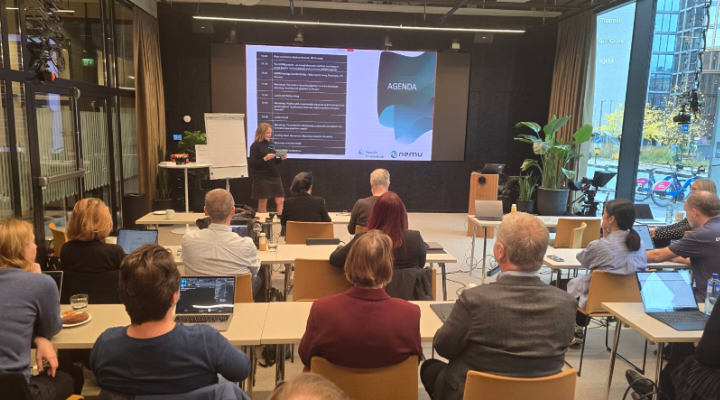
(Source: Nordic +)
"It’s not just talking about the need to cooperate more; we need to coexist more. We need to do something. And then the message will be that Nordic+ will help you to deliver"
“It won’t be easy,” she concludes. “It won’t just be a case of ‘let's just do a pilot to test it out’. It's baby steps. We need to start changing things to make it less fragmented. It’s about figuring out where to start, but you need to start somewhere. I think the important message here is that you have to do something rather than nothing.
“Because what happens is most people listen, and then they go home and say, that was interesting… but then they don't do anything. Because maybe they feel overwhelmed? Or maybe they think it's too complex and they need to start with a big picture? That’s not the case at all.”
Share your story
Do you have an innovation, research results or an other interesting topic you would like to share with the professionals in the infrastructure, traffic management, safety, smart mobility and parking industry? The Intertraffic website and social media channels are a great platform to showcase your stories!
Please contact our Sr Brand Marketing Manager Carola Jansen-Young.
Are you an Intertraffic exhibitor?
Make sure you add your latest press releases to your Company Profile in the Exhibitor Portal for free exposure.
Get up to speed on the mobility industry - our newsletter straight to your inbox!