
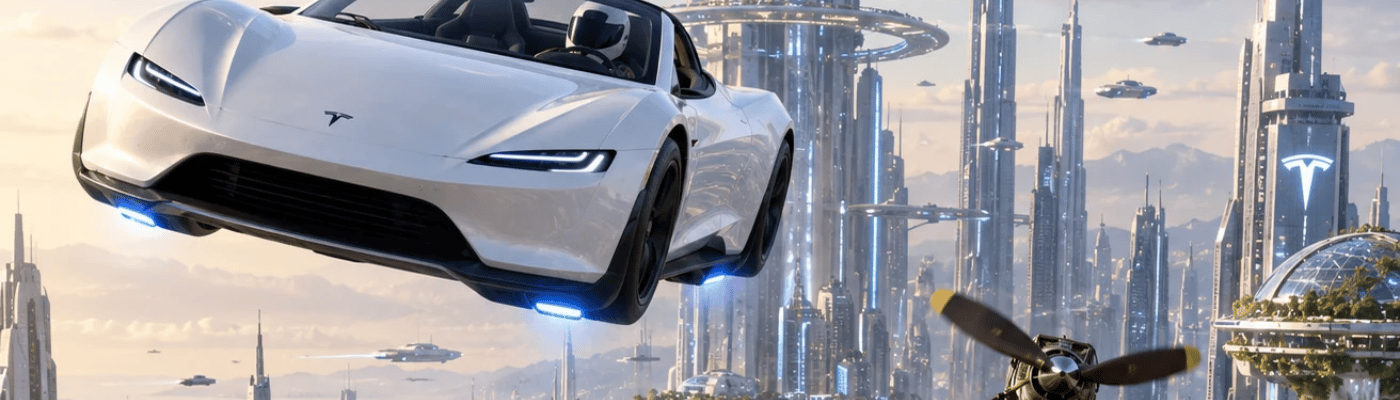
Higher Ambition
The flying car has finally arrived. So why isn’t that enough?
For decades, the flying-car dream has produced a succession of ingenious contraptions, many of which looked like ordinary cars that had lost an argument with a light aircraft. A field in the south-east of England, 1973: a brown Ford Cortina, wings and a small propeller strapped to its roof, accelerating into the horizon and the dawning realisation that the field wasn't quite long enough. The engineering challenge, as it turned out, was never simply to get a car into the air. It was to work out what happened next.
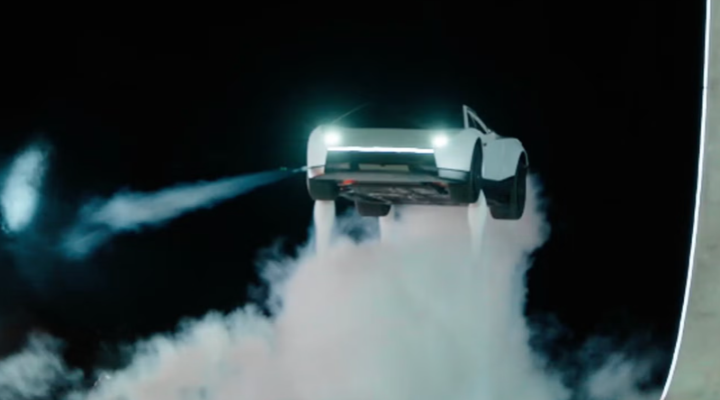
Elon Musk's airborne Tesla Roadster, as demonstrated at the SpaceX test facility in Texas in mid-October, may have fulfilled one of transport's oldest ambitions. For the automotive, mobility and traffic technology industries, the more interesting question is: “Now what?”
There are certain measurements that have become universal shorthand for progress. The size of a development is measured in football pitches. The height of a building is expressed in double-decker buses. Length, for reasons that nobody seems entirely able to explain, is sometimes calculated in brontosauruses.
And in transport, progress has always had one ultimate measure: the flying car.
Tesla's next-generation Roadster performed an airborne stunt using cold-gas thrusters and technology developed in collaboration with SpaceX. It flew, flipped and returned to earth. After decades of futuristic illustrations, ambitious prototypes and promises of a world without traffic jams, a car had finally done something that looked unmistakably like flying.
After decades of futuristic illustrations, ambitious prototypes and promises of a world without traffic jams, a car had finally done something that looked unmistakably like flying.
There is, of course, a considerable difference between a car that can briefly leave the ground and one that can fly from Amsterdam to Rotterdam in 11 minutes. Tesla's demonstration was not proof that practical flying cars are about to become commonplace, and the rocket-assisted Roadster is an experimental, highly specialised vehicle rather than a new form of everyday transport. Production is not expected before 2028, and its most radical capabilities face formidable regulatory obstacles.
Nevertheless, the symbolism matters. The flying car has occupied the transport industry's imagination for generations. If we are now beginning to cross that particular frontier, perhaps it is time to ask a more interesting question: what does the industry aspire to achieve when flying is no longer the ultimate ambition?
The dream that refused to die
The idea of a car that could escape the road is hardly new. Glenn Curtiss experimented with his Autoplane in 1917, while subsequent decades produced a succession of ingenious attempts to combine motoring and aviation.
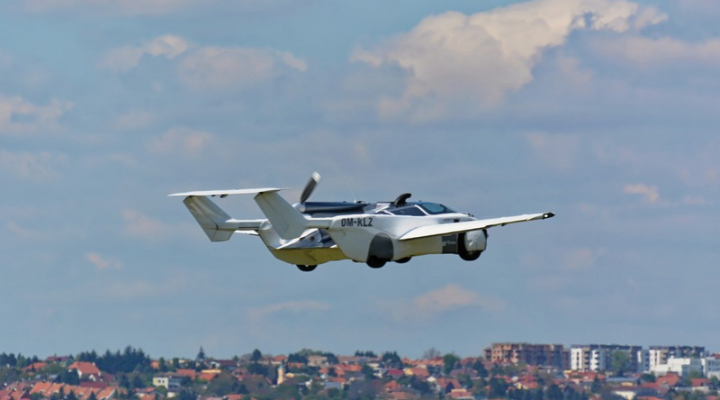
Some were more than publicity stunts. Robert Fulton's Airphibian became the first roadable aircraft to receive certification from the US Civil Aeronautics Administration in 1950. Moulton Taylor's Aerocar used folding wings and a propeller arrangement that could be converted for road use. More recently, Slovakia's Klein Vision (pictured) developed the AirCar, which received aircraft type certification in 2022.
Source: Marko58
The idea of a car that could escape the road is hardly new. Glenn Curtiss experimented with his Autoplane in 1917, while subsequent decades produced a succession of ingenious attempts to combine motoring and aviation
These machines were real engineering achievements. But they also illustrate the problem: building something that can both drive and fly is
not the same as creating something that people can use conveniently, affordably and safely every day.
The traditional approach generally involved compromises between two very different machines. Aircraft need wings, lift, lightweight structures and sufficient space for flight equipment. Cars need to fit into roads, parking spaces and urban environments. Combining the two often meant ending up with a vehicle that was neither an especially good car nor an especially good aeroplane.
The Tesla demonstration represents a different proposition. Rather than simply attaching wings and a conventional propeller to a road vehicle, it uses rocket-like thrust to achieve brief airborne manoeuvres. That is a
remarkable spectacle, but it does not solve the practical challenge of sustained flight.The distinction is important. Musk has demonstrated a new technological possibility, not the end of the flying-car development journey.
From flying cars to thinking roads
If the flying car has traditionally represented the pinnacle of transport innovation, what should replace it?
The obvious answer might be faster vehicles, autonomous taxis or aircraft that take off vertically from urban rooftops. All have a role to play. Electric vertical take-off and landing aircraft, for example, could eventually offer specialised passenger and cargo services, subject to safety, infrastructure, cost and regulatory constraints.
But perhaps the next great achievement will be less visually spectacular and considerably more consequential: a transport system that works as one intelligent network.
But perhaps the next great achievement will be less visually spectacular and considerably more consequential: a transport system that works as one intelligent network.
For decades, we have tended to develop transport modes and technologies in isolation. Automotive manufacturers improve vehicles. Road operators manage infrastructure. Cities plan public transport.
Logistics companies optimise deliveries. Technology suppliers develop sensors, software and communications systems.
The challenge is to make all these elements work together.Imagine a road network in which vehicles, traffic signals, roadside sensors and control centres continuously exchange information. Congestion could be anticipated rather than merely reported. Signals could respond to the movement of traffic, public transport could receive appropriate priority, and connected vehicles could warn one another of hazards before drivers encounter them.
Add increasingly capable automation, better predictive analytics and digital representations of the transport network, and the potential becomes significant. Instead of reacting to a traffic jam after it has formed, operators could intervene before it develops. Instead of treating every journey as an isolated transaction, the system could optimise the movement of people and goods across an entire city or region.
This is not science fiction. Many of the constituent technologies already exist. The challenge is integration, interoperability, deployment at scale and ensuring that the benefits reach road users rather than remaining confined to individual demonstrations.
For the traffic technology sector, that may be a more meaningful frontier than getting a car into the air.
Source: Tesla
The real breakthrough: fewer journeys ending badly
There is another possible answer to the question of transport's next great achievement: making serious road collisions an increasingly rare occurrence.
The industry's technological progress is undeniable. Vehicles are becoming more sophisticated, electrification is changing propulsion, and automation is opening new possibilities for managing movement. Yet innovation should ultimately be judged against the problems it solves.
There is another possible answer to the question of transport's next great achievement: making serious road collisions an increasingly rare occurrence.
Road deaths and serious injuries remain an enormous human and economic cost. Congestion wastes time and energy. Poorly coordinated
transport disadvantages people who cannot drive. Emissions and noise affect the quality of urban life.
A genuinely transformative transport system would address these challenges together.
Connected infrastructure could help warn drivers of dangerous conditions. Intelligent speed management could support safer roads. Better traffic control could reduce unnecessary stopping and idling. More effective integration of public transport, walking and cycling could make cities accessible without requiring everyone to own a car.
Autonomous vehicles, if they can demonstrate robust safety performance in real-world conditions, could also change how transport services operate. But automation is not an automatic solution: it needs reliable infrastructure, appropriate regulation, transparent performance evidence and clear accountability.
The achievement to aim for is not simply a vehicle that can travel faster, further or higher. It is a transport network that moves more people and goods with less risk, less waste and less environmental impact.
That is an ambition every bit as demanding as building a flying car.
What the flying Tesla means for the industry
None of this diminishes the significance of the Roadster demonstration. Its immediate contribution may be as much psychological as practical.
First, it reinforces the value of ambitious engineering. Technologies that once appeared implausible can become achievable when disciplines, expertise and investment converge. The relationship between Tesla's automotive engineering and SpaceX's aerospace capabilities is an illustration of what can happen when traditional industry boundaries become less rigid.
Second, it highlights the growing overlap between mobility sectors. Cars, aircraft, robotics, artificial intelligence, communications and energy systems are increasingly connected. The companies that shape the future may not fit neatly into the categories that define today's transport industry.
Innovation must ultimately operate in the real world, where
infrastructure has finite capacity, public money is limited, regulations matter and millions of people depend on reliable daily journeys.
Third, it reminds us that technological possibility and commercial viability are different things. An airborne stunt is not a transport service. A prototype is not a production system. And neither guarantees a safe, affordable or useful solution.
Source: Ffang
For traffic technology companies, this is an important distinction. Innovation must ultimately operate in the real world, where infrastructure has finite capacity, public money is limited, regulations matter and millions of people depend on reliable daily journeys.
The future will belong not just to those who invent extraordinary technologies, but to those who can deploy them responsibly and make them work together.
A higher ambition
Perhaps we should be careful about declaring the flying car to be the ultimate achievement of transport in the first place.
Its enduring appeal rests on a simple promise: freedom from the constraints of the road. Yet lifting individual cars above traffic would not necessarily eliminate congestion. It could simply move the problem into a more complicated, three-dimensional environment, with new demands for airspace management, landing facilities, safety systems and environmental controls.
The next generation of mobility will certainly include developments that seem extraordinary today. Some may involve flight. Others will involve autonomous vehicles, new forms of public transport, smarter logistics or technologies that we have yet to imagine. PULL QUOTE 6 The next generation of mobility will certainly include developments that seem extraordinary today. Some may involve flight.
But the most important breakthroughs may be less dramatic than a car performing an aerial flip in Texas.
They may involve traffic signals that communicate seamlessly with vehicles, road operators who can predict disruption before it happens, or transport networks that give people genuine alternatives to driving. They may be measured in lives saved, hours returned to commuters, emissions avoided or goods delivered more efficiently.
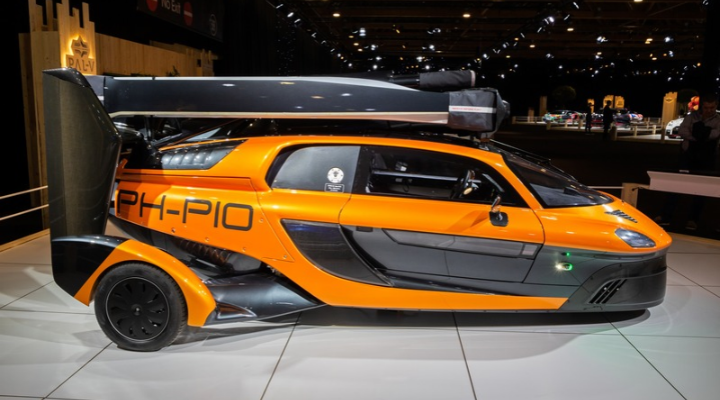
Source: VanderWolfImages
For an industry accustomed to measuring progress in extraordinary machines, these are less glamorous metrics. They are also much closer to what society needs.
Elon Musk may have given the world its most striking flying-car demonstration yet, but whether the Roadster ever becomes a practical airborne vehicle remains to be seen.
Either way, the challenge for transport is no longer simply to imagine what a vehicle might do. It is to imagine what an entire transport system could achieve.
And that, it must be said, is a considerably bigger (not to mention higher) ambition.
Share your story
Do you have an innovation, research results or an other interesting topic you would like to share with the professionals in the infrastructure, traffic management, safety, smart mobility and parking industry? The Intertraffic website and social media channels are a great platform to showcase your stories!
Please contact our Sr Brand Marketing Manager Carola Jansen-Young.
Are you an Intertraffic exhibitor?
Make sure you add your latest press releases to your Company Profile in the Exhibitor Portal for free exposure.


Get up to speed on the mobility industry - our newsletter straight to your inbox!