

BEYOND THE TECHNOLOGY
Sean Fryer on what regions and cities can learn from each other about delivering Intelligent Transport and why national and international collaboration matters now
Whether managing a major city or smaller region, transport authorities face similar pressures: rising demand, ageing infrastructure, constrained budgets and expectations for reliable transport. The question is how to make better decisions using existing resources.
Artificial intelligence, Digital Twins and ITS offer new ways to respond.
However, developing innovative technology is only part of the journey. The real challenge is translating that innovation into practical, operational capabilities that demonstrate measurable benefits.
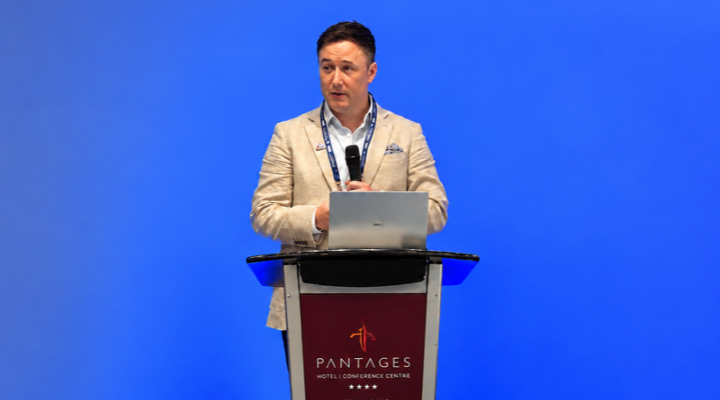
At the 2026 Global Cities Executive Summit in Toronto, I heard similar challenges discussed across very different networks. Why should every authority navigate them independently when we can learn from those further along?
Different Countries, Regions and Cities – Shared Challenges
At the Summit, hosted by the City of Toronto, perspectives from New York, Hamburg, Seoul (South Korea), Tees Valley and the Department for Transport (UK) highlighted how authorities are exploring ITS, Digital Twins, artificial intelligence and connected data systems to support transport planning, operational decision-making, strategic planning and network management.
What interested me was how differently they applied the data and technology.
One discussion that stood out was Toronto's use of a permit concurrency evaluation tool (Aimsun Roadworks) to assess overlapping roadworks and utility permits. Through modelling, the city can test scenarios before permit approval and coordinate approved works, helping anticipate cumulative disruption and make better-informed decisions.
Tees Valley was already exploring this approach. Hearing how Toronto uses it in practice provided valuable operational insight.
For me, that's where the real value of these conversations lies. It's not just about seeing what technology others are using, but understanding how they're actually using it.
One discussion that stood out was Toronto's use of a permit concurrency evaluation tool to assess overlapping roadworks and utility permits. Through modelling, the city can test scenarios before permit approval and coordinate approved works, helping anticipate cumulative disruption and make better-informed decisions.
Some authorities are using Digital or Visual Twins to evaluate future infrastructure investments, test scenarios and visualise complex transport challenges, including through virtual reality. Others are exploring how agentic AI and integrated data platforms can improve network understanding, communicate potential impacts and support more informed decision-making.
Tees Valley has initially focused on integrating Digital Twin technology into live traffic operations, enabling and evaluating automated interventions.
These approaches reflect different operational priorities and investment objectives, offering lessons without requiring every authority to follow the same path.
From Shared Ambition to Operational Reality: The Tees Valley Experience
In Tees Valley, our journey began with a relatively simple question: how could we make better use of the transport data and infrastructure we already had to move from reactive traffic management towards more predictive, intelligence-led operations?
We already had traffic management systems, roadside detectors and public transport data, but fragmented information limited our operational picture and ability to respond proactively.
We started with bus reliability because it addressed a regional priority, utilised existing data and provided opportunities for operational intervention. Importantly, it also offered measurable outcomes against which we could measure success.
Working with Aimsun, Yunex Traffic, our local authorities and wider technology partners, we subsequently delivered the UK's first operational, region-wide automated Traffic Digital Twin, covering approximately 1,780 miles of highway network across five local authority areas serving approximately 720,000 residents.
We already had traffic management systems, roadside detectors and public transport data, but fragmented information limited our operational picture and ability to respond proactively.
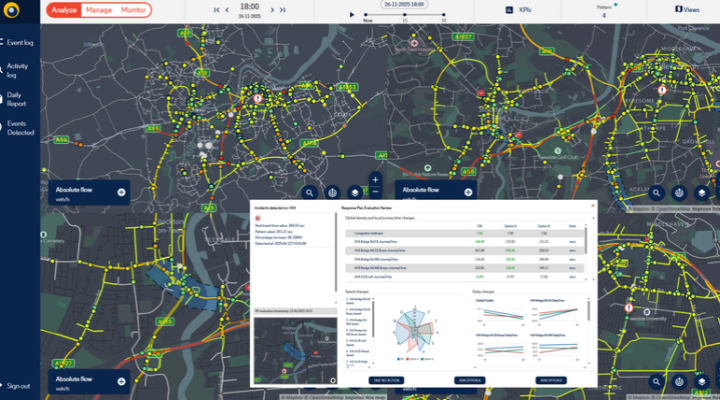
Unlike conventional analytical models, our Digital Twin uses live data to detect disruption, predict impacts and evaluate responses. Where an approved intervention is predicted to improve conditions, it can automatically implement strategies through existing UTC and UTMC infrastructure, turning predictive intelligence into operational action.
Crucially, we established monitoring and evaluation to assess whether interventions delivered tangible benefits. Across almost 3,600 operational evaluations, implemented strategies demonstrated an average of 15.9% reduction in journey times against a modelled do-nothing scenario, alongside improvements in observed bus-speed recovery following disruption.
Interestingly, the system determined that intervention was beneficial in approximately 53% of evaluations. In the remaining cases, taking no action was assessed as the preferable approach over the 60-minute forecast period. For us, that is an important distinction: intelligent traffic management should be about making better decisions, not simply automating more interventions.
The project has since been awarded national exemplar status by the UK Department for Transport, featured in the ITS Parliamentary Review and received multiple industry awards. International recognition followed at the 2026 Global Cities Executive Summit, where Tees Valley Combined Authority received the Smart Mobility Center's Smarter Traffic Technology Award.
For other authorities, the lesson is not necessarily to replicate Tees Valley's technology or approach. It is to recognise the importance of starting with a clearly defined operational problem, building on existing infrastructure, involving those responsible for managing the network and establishing the evidence needed to demonstrate value.
Ultimately, the success of an intelligent transport solution should be judged not by how advanced the technology is, but by what it enables an authority to do differently and the benefits it delivers.
For other authorities, the lesson is not necessarily to replicate Tees Valley's technology or approach. It is to recognise the importance of starting with a clearly defined operational problem
Lessons That Travel: What Other Authorities Can Apply
From our experience in Tees Valley, five principles stand out.
First, start with the problem, not the technology. Clearly defining the operational challenge and the outcomes you want to achieve should come before selecting a solution. Technology should respond to an identified need, rather than become the starting point for investment. A clearly defined problem also makes it easier to establish investment objectives, assess alternative solutions and demonstrate whether the eventual intervention has succeeded.
Second, build on what already exists. Many authorities have considerable investments in traffic management infrastructure, detection systems and operational data. The opportunity often lies in connecting these capabilities and making better use of them, rather than replacing everything.
Third, involve the people who will operate it early. Successful automation depends as much on operational acceptance as technical integration. Network operators need to understand how decisions are made, retain appropriate oversight and have confidence that new capabilities fit existing operational procedures.
Fourth, measure the outcomes and challenge the results. Monitoring and evaluation should be built into delivery from the outset. Establishing credible evidence of journey-time improvements, operational performance and economic value allows authorities to challenge assumptions, justify investment and make informed decisions about scaling or refining a solution.
Finally, plan for long-term sustainability. Securing capital investment to deploy innovative ITS solutions is one thing, guaranteeing the ongoing funding required to maintain, support and develop them is another. In Tees Valley, our funding arrangements have provided some short to medium-term certainty, but establishing a sustainable long-term operating model remains a challenge.
Securing capital investment to deploy innovative ITS solutions is one thing, guaranteeing the ongoing funding required to maintain, support and develop them is another.

From Knowledge Sharing to Collective Progress
For Tees Valley, international engagement is about more than showcasing achievements. It allows us to challenge our thinking, learn from different approaches and identify opportunities to inform future investment. Equally, sharing our experiences of business-case development, operational integration and benefits realisation can help other authorities avoid starting from scratch.
That exchange should continue beyond conferences. Through professional networks, industry partnerships and initiatives such as ITS North, part of ITS UK, we have opportunities to bring public authorities, suppliers and academia together to share practical knowledge and tackle common barriers.
No single city or region has all the answers. But by sharing what worked, what didn't and what we would do differently, we can help others to avoid making the same mistakes, inform investment decisions and accelerate the delivery of intelligent transport capabilities that genuinely benefit the communities we serve.
Share your story
Do you have an innovation, research results or an other interesting topic you would like to share with the professionals in the infrastructure, traffic management, safety, smart mobility and parking industry? The Intertraffic website and social media channels are a great platform to showcase your stories!
Please contact our Sr Brand Marketing Manager Carola Jansen-Young.
Are you an Intertraffic exhibitor?
Make sure you add your latest press releases to your Company Profile in the Exhibitor Portal for free exposure.


Get up to speed on the mobility industry - our newsletter straight to your inbox!