
Driver distraction: a graduated intervention
Is AI our greatest ally on the safe highways of the future?
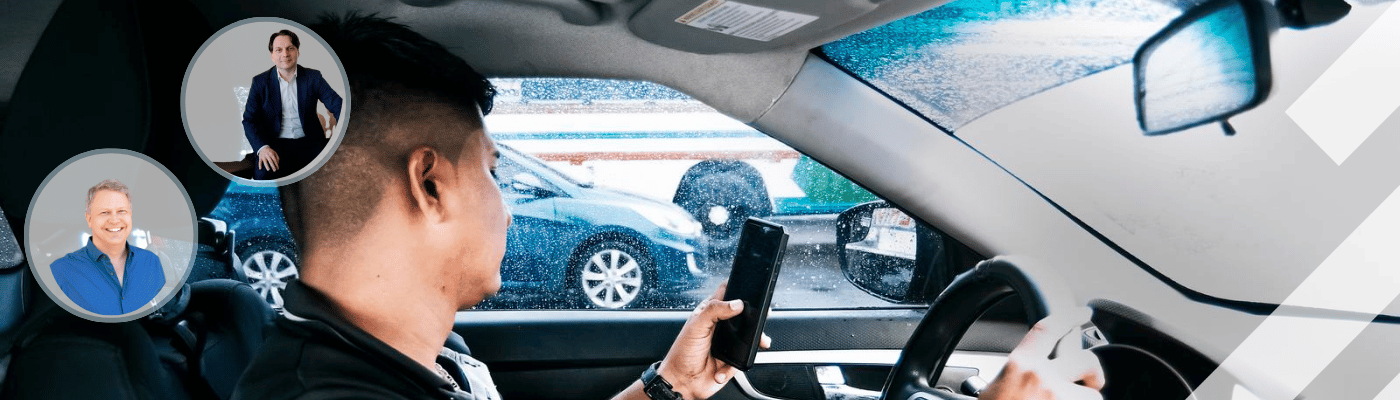
April 2026 was designated as world National Distracted Driving Awareness Month, a reminder that distracted driving remains a deadly problem. Based on the latest data from the European Commission, distraction is estimated to play a role in one in four of all road accidents in Europe so, as vehicle technology evolves, a key question is emerging: Can AI help prevent distracted driving before it even leads to a collision?
Intertraffic spoke with Dr. Stefan Heck, CEO of Nauto, a provider of AI-powered safety and operations solutions for commercial fleets, and Daniele Baldino, CEO of Auto Fleet Control, an advocate of the Nauto system, to discuss how AI-powered driver safety systems are helping fleets detect distraction in real time, teach and coach drivers ‘in the moment’, and even prevent crashes before they happen.
The notion of the distracted driver can be traced back to the first time that we fitted radios to cars. Naysayers were concerned that having something to do other than drive the car itself would be something of a danger, but fast forward to 2026 and the complexities of driver assistance systems and in-car entertainment has taken the potential for distraction to an unparalleled, perhaps even oxymoronic level. So where is the line behind help and hindrance?
“It’s in-car entertainment, but also food, having a passenger in the car, having a small child screaming in the backseat. Those distractions have always been there,” says Dr Heck. But if you look at the data, it is very clear that coincident with smartphone penetration into the population, both in North America and in Europe, you've had an increase in collision rates.
“And we see very clearly in our data that increase is due to an increase in distraction. Digital devices are designed to interrupt you;, they are designed to be addictive. If you think about things like Facebook and the nature of texts arriving in real time and the expectation to look at it in real time, things have become much worse. In the US we’ve seen a 40% increase in pedestrian fatalities, and I would say that 80-90% of that is due to distraction. I know most US and EU government statistics indicate 20-25% of collisions are due to distraction, but much of it goes unreported. In our fleet system 70% of collision damage involves distraction, or about three times what is reported in government statistics.”
Triple threat
People’s perception of their own distraction is also a cause for concern, as Dr Heck elucidates.
“We see very clearly that when you ask: ‘How often are you distracted?’ they'll say it’s maybe once or twice a day for a couple of seconds. The actual empirical data says seven times per hour and for an average of three to four seconds. And we see 15, 18, 20 seconds is not at all unusual. People totally underestimate how long they're looking away. In commercial fleets, we see they have a company phone and a personal phone and then in some vehicles there’s a tablet on top of that, showing the driver information, so now you've got three sources of distraction.”
.png)
“In the US we’ve seen a 40% increase in pedestrian fatalities, and I would say that 80-90% of that is due to distraction.”
It's at this point that artificial intelligence walks into the discussion.
“AI, I think, is on both sides of this argument. It’s being used in all these apps that can interrupt the driver more, but, in theory, AI can also help and benefit in those apps,” Dr Heck suggests.
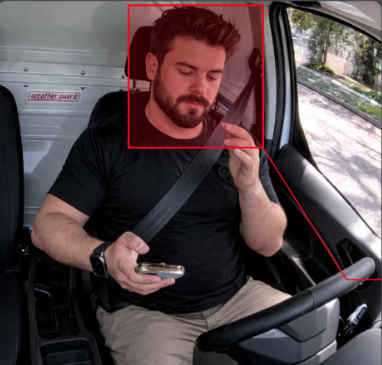
“If you have a voice interface and you can say, ‘play me this song’ as opposed to having to fiddle with the interface to locate that song, it can theoretically help. And then we're using AI specifically to detect the real- time dangers outside the vehicle - what's happening in front of you, around you, the vehicle itself, are you losing traction control, are you speeding, are you doing something dangerous as a manoeuvre? There is even more that AI can do by seeing directly inside the cabin: is the driver distracted or even falling asleep? And we do that by looking at what the driver is doing and what he or she is holding in their hand, what your eyes are looking at, and if you’re responding to a text or a pedestrian. We can see that you've got a phone up against your ear and your eyes are not looking at the road.”
What specific differentiators are there, then, between an AI-based system and a pre-AI-based system, as eye-tracking, in particular, has been in circulation for the best part of 18-20 years?
“That’s a great question,” says Dr Heck, “so I'll give some very specific examples. Let's start with the inside. The pre-AI systems shine an infrared light on your eyes based on the reflection of your retina versus the outer part of your eye. It's basically a dot and a circle. Based on how they move, you can tell where the gaze is directed and use that tracking in line with a set of explicit rules. The Euro NCAP standard has defined seven regions as Areas of Interest [road, infotainment system, rear-view mirror, driver’s side mirror, passenger side mirror, central console, multi-function steering wheel] and it tracks which of those regions you're looking at.
“And then it has specific time tolerance thresholds of how long you're allowed to look at one region before the system intervenes. So that's kind of the pre-AI version. It's basically detecting something about your face and then explicitly monitoring your gaze direction. What's changed as you go to an AI system is you layer recognition and detection of objects on top. For example, the AI can detect a phone and what I'm doing with it.
“Even if the system can’t see the driver’s eyes, the technology is still one step ahead. Let’s say I'm wearing a hat that covers my eyes or I've got sunglasses on, and you can't see my eyes at all. The system can still look at the rest of your body. We can tell, for example, that your head's tilted down and you’ve got a phone in the hand. That's very clearly still you looking at your phone.
“Even if the system can’t see the driver’s eyes, the technology is still one step ahead. Let’s say I'm wearing a hat that covers my eyes or I've got sunglasses on, and you can't see my eyes at all. The system can still look at the rest of your body”
“Whereas traditional’ systems use a radar or camera to measure distance to the vehicle ahead, and then carry out a differential speed calculation, what AI can do is it can look at the whole scene and calculate that not only is there a vehicle in front of me already, but it can see that the traffic lights are about to change or there's a pedestrian waiting to cross.
“You're able to detect more complex, second order effects of what's happening outside,” Dr Heck, winner of the 2025 AutoTech Breakthrough CEO of the Year award, explains.
“Another example is that AI can fill in missing objects. You might be in a car park, there's a pedestrian's head bobbing along, and it disappears behind a car. The AI can know that a pedestrian was there, that's still dangerous, even though I can't see the pedestrian right now. A traditional system would look literally at your lane of travel and says, is there an object in that lane of travel? And is that a pedestrian or a car?”
A graduated intervention
On the subject of human-machine interface (HMI), how does Dr Heck and his Nauto colleagues see AI benefiting the sides of that coin?
“Our whole approach is really centred on that question, because we try to intervene in a graduated way. It starts with nudges if you're doing something dangerous, but there's no imminent risk. If you're speeding, we'll have what's called an earcon. It's a little sound, very subtle. It's not intrusive. It suggests slowing down. So that's the gentlest intervention if you're doing something dangerous, but there's no imminent threat. We use voice coaching to give clear instructions but in a friendly, collaborative tone. If I'm making a phone call, it will tell me to pull over to use my phone. We always do it in a positive way because we see it gets about 20% more behaviour correction when you do it positively, because that driver has a need, right?”
“We're trying to give the driver an earlier chance to correct and give them a heads up. Ideally, we get their eyes back on the danger on the road and they do something more intelligent than braking”
“Sometimes you have to talk to your mum or your boss. By telling drivers to pull over to use their phones’ you're giving them the suggestion of what to do. The last stage is active safety where you're triggering braking. In the future, you'll also be able to trigger swerving, which in many cases is a better response behaviour since braking can still result in damage to goods in the vehicles and to occupants not wearing their seatbelt.
“We're trying to give the driver an earlier chance to correct and give them a heads up. Ideally, we get their eyes back on the danger on the road and they do something more intelligent than braking. And we see this in our data. If you look at the best drivers, drivers that have driven for decades without having a collision, they tend to steer rather than brake as a correction. And in most situations, steering is better because you have less risk of losing control, less risk of other people making a mistake.”
A SERIES OF CONSEQUENCES
From Daniele Baldino’s perspective, it’s a simple matter of saving lives, beyond the technological wizardry.
“What we see is that all these devices we currently have, from a conventional perspective, are not meeting expectations,” says the CEO of Hamburg-based Auto Fleet Control.
“In terms of telematics, all these gadgets within the car, we don't see an improvement in terms of frequency, and this is why we started to discuss and consider different solutions. The trigger was not to say that we need a fancy gadget, the trigger was we had really serious accidents that were injuring drivers and jeopardiszing their lives.
“Stakeholders within the company are approaching you and asking the question, ‘Why did it happen and how can we prevent it?’ And this is how we started the discussion because we had two major injuries with heavy damages. It was costly in terms of repairs, but it was painful as well in terms of the injured technicians because then you lose time slots for your customers, and you lose money. You cannot offer the service you intend to. It's a series of consequences. We are seeing that telematics solutions didn't deliver on the promise. So honestly, from our results, we couldn't make a clear calculation that have an impact on frequency. Then we started to work with Nauto on a major fleet in Germany… and here we are.”
A HELPING HAND
The relationship between encouragement, compliance and enforcement is quite a complex one, so how does Dr Heck see that evolving?
“We try to make sure we're on the side of the driver. We make a promise that the driver always gets to hear anything, any risk we detect, first before it goes to their boss. That way, they get a chance to do something about it. It’s designed explicitly not to be any kind of spying technology, but rather a co-pilot or guardian angel.
“Our design goal is for the driver to embrace and love the technology. I'm not going to claim that every driver loves it, but I've interviewed a lot of drivers and they either say, it’s really cool and it's helped save my life a few times, or they say they don't need it as much as other drivers, but on balance they understand it helps them stay out of trouble.”
SHARE ISSUE
Of course, any such solution’s popularity is correlated with the riskiest drivers that are driving dangerously and have the lowest scores because they trigger the most interventions.
“One of the things that Daniele can talk about that he's done really well in his company is to take that transparency and driver engagement a step further. The process of how you introduce the technology is quite important.”
“Our goal is for the driver to embrace and love the technology. I've interviewed a lot of drivers and they either say, it’s really cool and it's helped save my life a few times, or they understand it helps them stay out of trouble”
“Absolutely,” replies Baldino. “From my perspective, we had three thresholds we had to go through. The first thing was we had to solve all the legal GDPR topics. We found a solution where a lot of lawyers said this is how we can tick the box and it can work. The second was how do we get acceptance from the social partner, so our works council, as an example. And of course, the drivers.
“The first thing was we had to separate from an organisational perspective who's collecting the data and who's using it. Because we said so, we as Auto Fleet Control are collecting the data and talking to the driver and we're not sharing it with your boss. We have a mandate to support you in your security and to improve your behaviour in terms of driving. But we are not supposed to share it with your boss.
“We can differentiate what is going to the boss and to the company and what is going to the driver. And that was a key topic in increasing use acceptance and usage. The second was that we made a marketing campaign and a road show within the whole fleet in Germany to explain the device, the solution and the benefits for the driver, one that maintained that an angel is basically supporting you or following you and preventing you from any danger. What we did in the end was quite sophisticated. We likened it to building a plane while flying!”
“We created a marketing campaign and a road show within the whole fleet in Germany to explain the device, the solution and the benefits for the driver, saying that an angel is basically supporting you and keeping you from any danger. We likened it to building a plane while flying!”

(Source: Nauto)
DETECT & SURVIVE
Finally, how does Dr Stefan Heck see the near future for AI-powered driver distraction solutions? What’s next on the horizon, artificial or otherwise?
“I'll give you two quick reactions. One is that I see cities upgrading - high traffic locations with infrastructure upgrades. And there's lots you can do with AI cameras that are aware of traffic, and dynamic speed signals that you see on many motorways. It’s an expensive way to go, though, and you certainly cannot upgrade the entire road network of even a modest-sized country like Germany or the UK, let alone the US with so many more miles of road to cover. So, it's much cheaper to upgrade the vehicles.
“The fleet turns over in about 12 years on average versus infrastructure where you are essentially talking about decades. It's faster and cheaper to put stuff into the vehicle than it is to upgrade the road.
“One of the easiest things a city can do to make AI deployment easier is to make sure all the signs and lanes are clearly visible,” he concludes.
“So that just tells you there's this interplay between the sensors on the vehicle and in the quality of the infrastructure. And it goes the other way too. Any of our vehicles can detect infrastructure issues. “For the next few years expect a lot more AI safety upgrades to vehicles with Europe leading the way given the regulatory push through EuroNCAP safety standards incorporating the capabilities AI brings.”
“The fleet turns over in about 12 years on average versus infrastructure where you are essentially talking about decades. It's faster and cheaper to put stuff into the vehicle than it is to upgrade the road”
Share your story
Do you have an innovation, research results or an other interesting topic you would like to share with the professionals in the infrastructure, traffic management, safety, smart mobility and parking industry? The Intertraffic website and social media channels are a great platform to showcase your stories!
Please contact our Sr Brand Marketing Manager Carola Jansen-Young.
Are you an Intertraffic exhibitor?
Make sure you add your latest press releases to your Company Profile in the Exhibitor Portal for free exposure.

Get up to speed on the mobility industry - our newsletter straight to your inbox!