

MoLoHubs: supporting parking management, one space at a time
MoLoHubs is a European-funded project from the Interreg North Sea Region programme creating multifunctional mobility hubs that cluster services for logistics and passenger mobility. The hubs support parking management by providing shared infrastructure and reallocating space. It does so also by piloting different hub concepts across the North Sea Region, among them Park and Switch (P+S), which enables service technicians to park at hubs and swap into adapted light electric vehicles, cargo bikes, microcars or mopeds to operate within low-emission zones. Daniel Herrera Meek, project coordinator at POLIS, partner in the MoLoHubs Project, sat down with Intertraffic to discuss multimodal parking management strategy.
Intertraffic: MoLoHubs - can you talk us through the modus operandi of the project? We know what it is but what are its aims and what do you hope to achieve?
Daniel Herrera: MoLoHubs is a European-funded project that is working towards mobility hubs for logistics and passenger mobility. Basically the hubs in question are physical infrastructure where you're clustering many services. When you are developing this infrastructure, you have to take up space so it must be multifunctional and have several uses. In that way, it can support parking management. For instance, we have an interesting case, which is in the city of Amsterdam where they are piloting one of these hubs to promote the ‘Park and Switch’ service for technicians that need to enter the low-emission zone in Amsterdam, which is the inner circle of the city. So, for instance, normally these technicians travel in large vans but they need to enter these areas that lack appropriate space. They're very congested and it's difficult to get around. The technicians lose time looking for a parking space and so on.
“The city of Amsterdam is piloting one of these hubs to promote the ‘Park and Switch’ service for technicians that need to enter the city’s low emission zone”
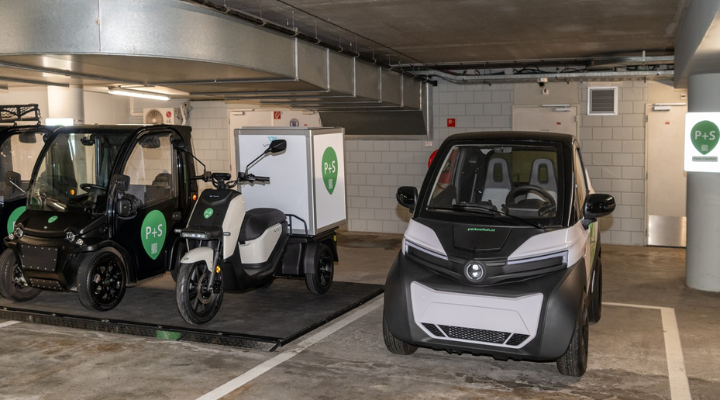
This way they have a hub where they can leave their vans, pick up a light electric vehicle, because the running of the pilot has shown that they need a specific type of vehicle with a specific type of configuration so they can carry all their equipment and the tools they need.
They can either take a cargo bike or a micro car or a moped, and they can leave their van safely and they can go into the city. That’s just one example of how these hubs could support parking management in this type of context of very dense cities.
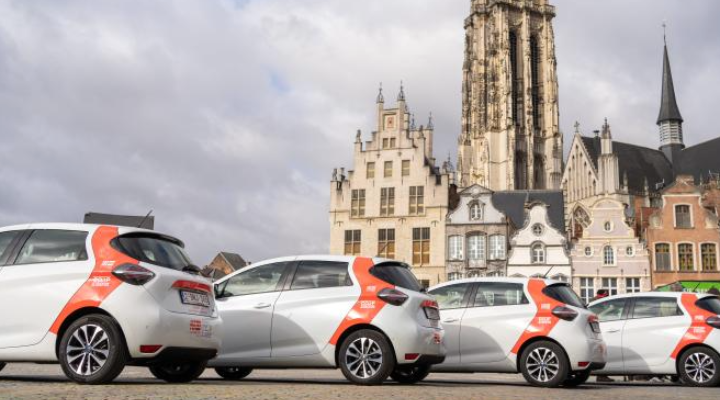
MoLoHubs combines mobility hubs and logistics services to improve quality of urban life and boost mobility transition. Five pilots will make an important contribution to reducing urban traffic, increasing the attractiveness and functionality of urban mobility hubs and also give an insight into how user-centred logistics services can be designed. The pilots are in Aalborg, Amsterdam, Borås, Hamburg and Mechelen.
“MoLoHubs combines mobility hubs and logistics services to improve quality of urban life and boost mobility transition”
Intertraffic: What about from an urban planning perspective?
DH: It's not directly linked to the project, but for instance, often with mobility hubs can be when you are as an urban planner, you are designing the city, you have designated a plot, a piece of land to be developed and you as a real estate developer come and build. So, cities are often incentivising the construction of mobility hubs to cluster shared mobility so you can reduce parking spaces, or you can save space by not building parking structures or using space for parking. And so, people can actually use shared mobility and that has incentives such as the apartment unit is cheaper, for instance, because the developer doesn't have to build parking spaces.
Intertraffic: Is this a case of facilitating the idea of a fairer allocation of public space by intrinsically moving away from the notion of the car-centric city?
DH: By implementing this type of hub we have the chance to redesign and reallocate city space more efficiently. For instance, when you're designing, you can think of how to reallocate the space, so you might allocate more space for sustainable means of transport, and then it's also a policy that needs to be accompanied with a lot of communication initiative, a lot of discussion with the residents, with the potential users, so they know that there is an alternative beyond the car.
“By implementing this type of hub we have the chance to redesign and reallocate city space more efficiently”
This is something that needs to be discussed widely because it's not about just taking away your parking spot and then building this infrastructure without having really discussed it and ending up with a sort of bottom-up approach with the communities on what's best for them, on what could work. If a city has a hub network or is implementing this kind of infrastructure, they need to have an understanding of what's happening in the streets - what are the circulation flows, how do people move around, what are the points of interest? There needs to be a very thorough understanding of different aspects so they can actually provide the right infrastructure, the right hub, when it comes to which type of vehicles, when it comes to location, when it comes to design of the infrastructure, when it comes to potential links to other modes of transport.
Intertraffic: What types of technology are we talking about in terms of facilitating this vision of a mobility utopia?
DH: At POLIS, as a cities network, we acknowledge industry and we are aware of the technologies that are out there to support parking management, enforcement and space reallocation, but we're mostly focusing more on the public sector from the governance perspective, from the cities side and not so much from the industry.
I think these are the key elements of this type of infrastructure. If you have this linked to a multimodal mobility strategy led by the public sector, then this type of infrastructure can become important in order to facilitate the efficiency of urban freight, and also parking management and passenger mobility. Of course, this dialogue must involve industry, and as many key mobility stakeholders as possible. The concept of mobility hubs is very flexible, but it's a concept that supports many aspects of mobility.
Intertraffic: Finally, Daniel, can you tell us something about Curb Data Specification - it seems that many cities in Europe are using this system to get a better understanding of the current usage of their kerb space, to use European spelling.
DH: Cities have access to tools that help them understand what's happening in their kerb space, so for instance CDS is a standardised framework that allows you to manage kerb space effectively. CDS APIs are used to share static and dynamic kerb regulations, measure activity at the kerb, and provide analysis for kerb managers and users. The standard is supported by the Open Mobility Foundation (OMF), a POLIS-associated partner, which is a US open-source foundation that creates a governance structure around open-source mobility tools.
CDS is endorsed by the Open Mobility Foundation who are based in Seattle and many European cities are using this to understand what's happening to their kerb space. You can communicate information in real time and also the cities can communicate regulations, enforcement, and so on. This allows them to understand what's happening on the ground and allocate space dynamically. A space that could be used for loading or unloading goods at a certain period of the day can then turn into a parking space after a certain time, or if you need to manage specific events then you can communicate different uses for that space based on the event you have in your city.
“A space that could be used for loading or unloading goods at a certain period of the day can then turn into a parking space after a certain time”
For more information on MoLoHubs, visit https://www.interregnorthsea.eu/molo-hubs
Share your story
Do you have an innovation, research results or an other interesting topic you would like to share with the professionals in the infrastructure, traffic management, safety, smart mobility and parking industry? The Intertraffic website and social media channels are a great platform to showcase your stories!
Please contact our Sr Brand Marketing Manager Carola Jansen-Young.
Are you an Intertraffic exhibitor?
Make sure you add your latest press releases to your Company Profile in the Exhibitor Portal for free exposure.

Get up to speed on the mobility industry - our newsletter straight to your inbox!