.png?h=400&iar=0&w=1400)
Loading component...
A STRATEGIC REINVENTION: RENEWABLE ENERGY IS REVOLUTIONISING HIGHWAY CONSTRUCTION PROJECTS
The traffic and transport technology sector is under pressure to meet environmental targets. How, then, are those targets going to be met? One solution that is perhaps doing as much as any to “green” the industry is the use of renewable energy in the construction and maintenance of highways and motorways – edging away, slowly but surely, from a reliance on diesel-powered generators and transitioning to solar- and alternative-energy-powered lighting and electricity. This is nothing short of a strategic reinvention.
Intertraffic spoke to two British companies at the forefront of a movement that is not only helping the environment but proving to be highly cost-effective, too.
Firstly, Prolectric is an engineering and manufacturing specialist in off-grid, solar-powered street and temporary site lighting, hybrid power generators and battery energy storage solutions for the construction and infrastructure sectors, to name but two.
Among a number of high-profile projects to which the company, based in the South-West of England, are providing the sustainability angle is the huge A417 Missing Link in Gloucestershire – essentially the environmentally friendly construction of an equally environmentally friendly 4.5km stretch of dual carriageway that should have been built over 50 years ago but wasn’t due to the topographic complexity and environmental delicacy of its location slap-bang in the middle of the Cotswolds, one of the UK’s most stunning Areas of Outstanding Natural Beauty. One of the project’s modus operandii is that it should have a minimal environmental impact while it’s under construction and once it’s completed next year.
And for equipment hire companies, the strategic switch from diesel to solar and battery energy storage system is making good business sense on a number of levels, with renewable, off-grid products and equipment commanding a price premium, over their diesel counterparts, often with much higher rental utilisation.
.png)
Prolectric ProCharge Solar Battery Energy Storage System (BESS) by Prolectric
Kathryn Adams, Director of Product at Prolectric, says that making highway and motorway construction and maintenance more sustainable is all in the planning and revolves around the intelligent use of renewable energy. So, what’s the key to turning what is clearly a brilliant and noble idea into reality?
“Just make sure that people plan appropriately.” she replies instantly.
“Work with your supply chain very early on to ensure that the most environmentally sustainable equipment is specified where it can be. There's usually a clear understanding of what’s needed and when the site is going to be operating. Ask yourself, if it's relatively low energy use, is there an alternative source?”
That sounds like that should be the first box on the checklist, but it isn’t always the case.
“Often people automatically go for a diesel generator, but particularly with smaller stuff such as like lighting towers, site security or anything requiring power below 10 kWs, there are really viable alternatives that are renewable or at least reduce the amount of fossil fuels that you're using,” she explains.
“Solar lighting towers, for example, are more than adequate and can have a really significant impact if you're running lighting every single day, they also tend to be the first thing deployed on site and the last thing that leaves. You need to look at the equipment that you're using and scope out whether there is a renewable alternative early on. It's also important to set the principles early as well. If you are determined as an organisation to reduce your carbon footprint, make sure that everybody on the project is aware of that be that a project manager, QS or, operatives on site, and also maybe an understanding that that there might be some education needed around it.”
We often talk about engaging with and educating the public, or the end users, but in this instance, Kathryn Adams is referring to the suppliers and other project stakeholders?
“Yes, absolutely. You may need to disprove misconceptions around some of the equipment or fears around renewables maybe not being as reliable as fossil fuelled equiptments. Your supply chain can definitely support you to improve that understanding across the business.”
Kathryn believes that it's more important to start off with a sustainable mindset than to start off with a regular diesel-powered mindset and then adapt it to match the project’s environmental requirements.
“The principles have to start from scratch. I think very often the biggest challenge that we face is that people are just so accustomed to what they've always done, you have to challenge that, and I think that challenge has to be addressed upfront and really clearly. A lot of the time you've got a procurement team that’s got one objective to purchase the cheapest possible equipment, and you've got a project manager that's looking to minimise their operational costs. If those two joined up a little better and looked at the whole life cycle cost of equipment, very often your renewable equipment is much cheaper to run. Some common misconceptions can be allayed quite simply if they are aware that when the CAPEX and OPEX (capital expenditure and operational expenditure) costs are combined renewables are very favourable - plus, of course, you've got carbon savings on top of that.”
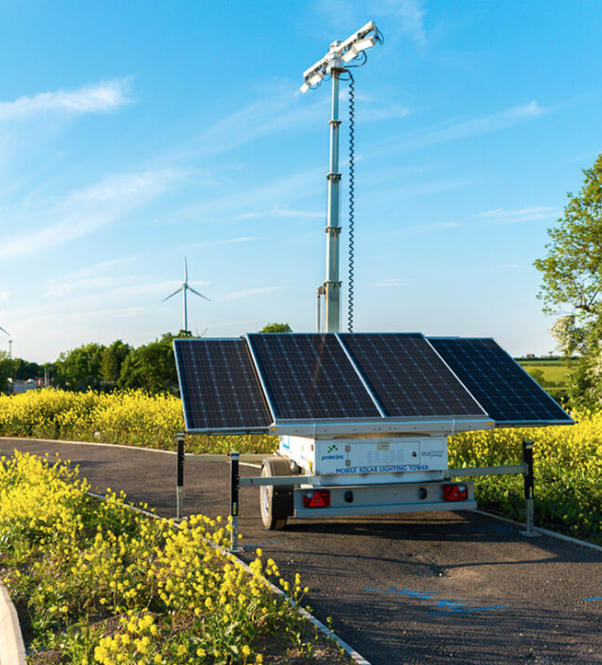
Solar powered highway construction lighting by Prolectric
Take the cold, hard facts of the A14 project in Cambridgeshire in the East of England as a case in point. National Highways teamed up with Prolectric and this saw the use of temporary solar lighting towers saving over 1,000 tonnes of CO2e during the course of the project, contributing significantly to the agency’s environmental impact goals.
The project benefitted from a total saving of 360,000 litres of diesel and a massive saving of £540,000 in fuel costs, but perhaps most notably the disruption to local wildlife was reduced, largely due to less noise from diesel generators and site operatives benefitted from quieter working environments.
Talking of environmental impact goals, Kathryn Adams has identified a lack of realisation by local authorities and project stakeholders that those targets are not just numbers plucked out of the air – every single one of them means something and represents something real.
“They've all set really challenging net zero carbon reduction targets, and they're obviously mandating it as part of a lot of the tenders and the contracts that are being worked on – but whether that realisation is really hitting home at a decision on site remains to be seen. Who is managing that spend, who is managing the contractors? I just think that's what we're missing now. You have to take into consideration the volatility of costs with fossil fuels. “
How, then, does a battery energy storage system and hybridized system work and how do you go about explaining its myriad benefits to, let’s say a local authority that has not noticeably changed the way it tenders for road construction projects since the 1990s?
Says Kathryn: “You now have systems that can be coupled. So for example, our ProCharge, it's 100kW hours of battery storage that can be coupled with a diesel or HVO compatible generator, it has a 5kW peak solar array, so it will generate energy from the sun that will go into your batteries or it can power the site directly. Your generator charges up your batteries and then you're able to use those batteries over a period of time that replaces the diesel generator use. I'm assuming that most people already understand this, but some just don't.
“ProCharge will do small plant, such as diggers, sleeping accommodation, bunker bins, site eco-cabins, scissor lifts and pumps. Anywhere you're using an electric plant, the ProCharge and ProPowers, can be used to replace a diesel generator with a renewable system.”
As Prolectric’s MD John Foster says it so eloquently, the switch to renewable energy-powered highway construction projects is the ultimate epitome of the win-win situation in a geo-politically volatile and economically unstable era the likes that many have never seen before, or at least for maybe half a century.
“For many companies, the adoption of more sustainable business practice is having a halo effect, helping to enhance brand reputation, and attract more environmentally conscious clients who share similar values,” he says.
“The strategic reinvention and repositioning of traditional diesel-dependent businesses is clearly paying dividends.”

.png?h=628&iar=0&w=1200)