
Deep Impact
ARE EUROPE'S ROAD RESTRAINT SYSTEMS KEEPING PACE WITH MODERN TRAFFIC?
Recent crashes have renewed scrutiny of Europe's motorway safety barriers. However, understanding containment failures requires a closer look at vehicle mass, impact conditions, performance standards and the lifecycle management of roadside infrastructure.
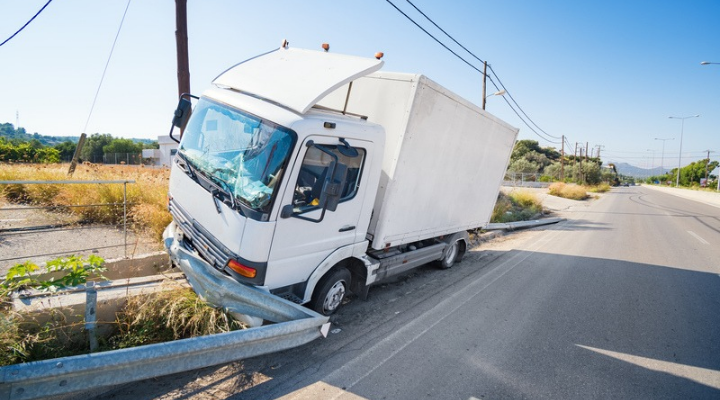
Source: Lubos K
A series of serious crashes across European motorways has brought a familiar but increasingly urgent question back into focus: are the road restraint systems protecting Europe's busiest routes capable of dealing with the vehicles using them today?
The question has gained particular attention following incidents involving heavy goods vehicles breaching central reservations, as well as crashes in which vehicles have penetrated barriers on elevated sections of motorway. Industry representatives have argued that the widespread use of lower-performance steel barriers leaves parts of the network vulnerable, and that the move towards more robust concrete containment systems needs to accelerate.
There is a compelling case for examining the resilience of Europe's roadside infrastructure. But the debate should not be reduced to a straightforward assertion that electric vehicles are heavier, or that steel barriers are therefore no longer fit for purpose. The engineering questions are more complex, and the consequences of getting them wrong extend beyond the immediate crash site.
A changing vehicle fleet
The growth in the number of electric vehicles (EVs) on European roads has introduced new considerations for road restraint system designers and asset owners. Battery-electric vehicles can be substantially heavier than comparable internal combustion engine (ICE) vehicles, with battery packs contributing significantly to their kerb weight. Large SUVs and other heavier passenger vehicles have also changed the composition of the traffic fleet.
Vehicle mass is relevant to crash energy. At a given speed, a heavier vehicle has greater kinetic energy, and the energy that a restraint system must manage depends on the circumstances of the collision. However, mass alone does not establish whether a barrier will contain a vehicle. Speed, impact angle, vehicle geometry, the point of contact, the barrier's configuration and the condition of the installation all influence the outcome.
This is an important distinction for highway authorities. A restraint system is not designed to withstand every conceivable impact; it is tested to defined performance conditions. The engineering question is whether those conditions remain representative of the risks posed by the current vehicle fleet and the locations in which the system is installed.
Dr José F. Papí, President of the Smart Transportation Alliance, CEO at Etelätär Innovation, and an expert on the topic of road restraint systems, has cautioned against drawing conclusions from materials alone, a debate largely settled three decades ago with the approval of European norm EN1317.
“European road restraint standards are performance-based, assessing containment, impact severity and deformation under defined crash-test conditions,” he says. “Establishing the cause of an individual breach requires an independent reconstruction that examines speed, angle and the other conditions of the impact.”
That is a valuable starting position. It also points towards a wider question: whether the assumptions underpinning existing restraint system selection and deployment are still appropriate across Europe's changing road network.
The M66 and M6: two incidents, different lessons
The debate has been sharpened by a spate of incidents on the UK's motorway network.
On 4 June 2026, a lorry towing a trailer carrying a road roller crashed into the central reservation on the M66 between the A56 at Edenfield and Junction 2 in Greater Manchester. According to National Highways, the vehicle subsequently jack-knifed and came to rest on the nearside carriageway.
The crash caused significant damage to the central reservation and verge-side safety barriers. The resulting recovery, repair and traffic management operations led to an extended closure, with reports of disruption lasting for over nine hours.
National Highways said the barriers involved met the applicable safety requirements and that the systems had performed their intended role by preventing the HGV from crossing the carriageway. The authority also emphasised that motorway and major A-road barriers are subject to impact testing involving vehicles of different sizes and weights, including cars, HGVs and coaches.
Britpave, the infrastructure industry association, offered a different perspective. It argued that lower-performance steel barriers can be vulnerable when struck by larger vehicles and called for a greater use of rigid concrete barriers, which it says can provide higher levels of containment and reduce the extent of repair work following certain collisions.
A subsequent incident on the M6 at Keele in Staffordshire, reported on 21 August, further illustrated the potential consequences of a central reservation breach. A southbound lorry travelling between Junctions 14 and 15 crossed through the steel barrier into the path of northbound traffic before colliding with barriers protecting a motorway bridge pier. The concrete protection at the bridge was able to contain the vehicle.
The two incidents demonstrate why the performance of roadside restraint systems deserves close attention. They do not, however, establish a single cause or prove that every steel barrier on the network is unsuitable for heavy vehicles. The performance of a system must be considered in relation to its design class, installation, maintenance and the actual forces generated during the crash.
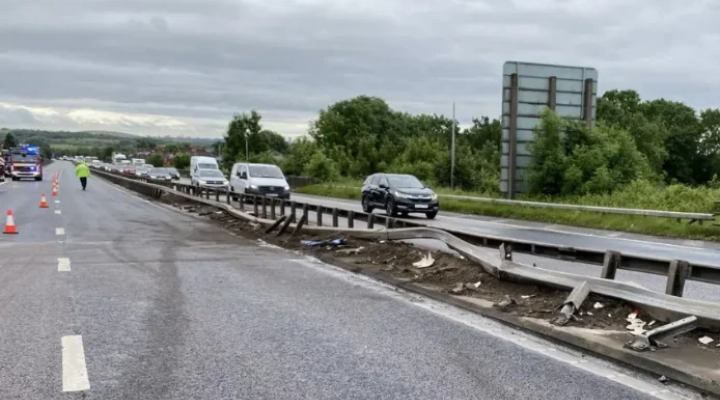
Source: National Highways
Steel versus concrete: a question of application
Britpave's advocacy for rigid concrete barriers reflects a longstanding engineering debate about the respective characteristics of flexible and rigid restraint systems.
Concrete barriers can offer significant advantages in locations where preventing vehicle crossover or protecting critical infrastructure is the primary objective. Their rigidity and containment characteristics may reduce the risk of a vehicle penetrating a central reservation or reaching a bridge pier. Depending on the design, they can also reduce the need to replace extensive lengths of damaged flexible barrier following a collision.
But concrete is not a universal answer to every roadside safety problem. The selection of a restraint system must consider the required containment level, working width, deflection, occupant risk, installation constraints, drainage, maintenance arrangements and the consequences of an impact for road users.
A rigid barrier may be appropriate in one location and a flexible system in another. The objective should be to select and maintain a system that provides the required performance for the specific hazard and traffic conditions, rather than to treat one material as inherently safe and another as inherently unsafe.
The more immediate concern is whether existing assets have been assessed against those requirements, and whether replacement programmes are keeping pace with their condition and operational importance.
Testing standards and the question of future vehicle weights
European restraint systems are assessed under the EN 1317 framework, which establishes performance requirements and test methods for road restraint systems. The framework is central to the design, classification and deployment of barriers and related equipment across Europe.
There is ongoing discussion within the industry about whether crash-test approaches and vehicle categories adequately reflect the modern traffic fleet. In particular, the increasing prevalence of heavier SUVs, EVs and other large vehicles has raised questions about how representative existing test configurations are of real-world collision scenarios.
Such concerns should be examined through evidence rather than assumed. A comparison between European and US test regimes must account for differences in test vehicles, impact conditions, performance criteria and how systems are approved and deployed. A test protocol cannot be judged solely by the nominal mass of its test vehicle.
Projects intended to improve the relevance of restraint system testing and vehicle compatibility therefore warrant close attention from road authorities, manufacturers and independent researchers. Any revisions should be based on robust accident data, full-scale testing and a clear understanding of the risks that systems are expected to manage.
For asset owners, the practical question is not simply whether a future standard will require a different barrier. It is whether the current network contains installations whose original performance assumptions, condition or location now justify reassessment.
The overlooked issue: infrastructure lifecycle management
The focus on EV weight and containment technology risks obscuring a more established and equally important issue: the condition and management of existing road infrastructure.
Road restraint systems are safety-critical assets. Like bridges, pavements and tunnels, they require inspection, maintenance, repair and eventual renewal. A system that met the relevant requirements when installed may need to be reassessed if it has suffered repeated impacts, deteriorated, been modified, or become inappropriate for changes in the road layout or surrounding hazards.
Dr Papí's warning about the lifecycle of road equipment is particularly relevant here. Sustained investment in inspection and timely renewal is essential if the network is to retain both its safety and operational performance.
The question for highway authorities is therefore partly one of prioritisation. Where budgets are constrained, should expenditure focus solely on replacing visibly damaged or end-of-life barriers, or should it also address locations where the consequences of a containment failure would be especially severe?
Central reservations, bridge piers, elevated carriageways and areas with substantial traffic flows may warrant a risk-based approach to investment. Such an approach would consider the likelihood of a collision, the severity of the potential consequences, the existing restraint system and the practicality of alternative protection.
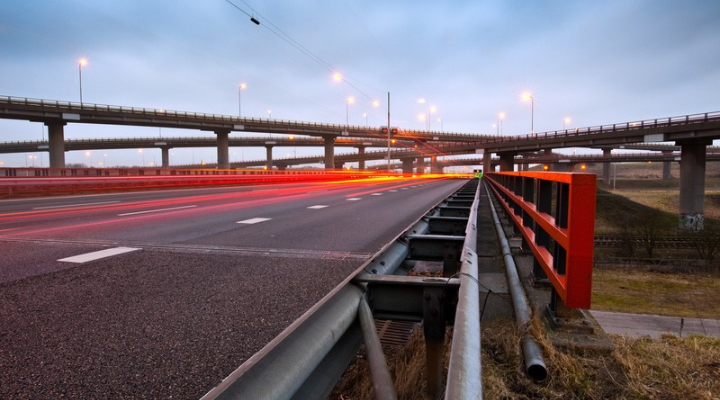
Source: Corepics Vof
Learning from incidents without oversimplifying them
The recent crashes should prompt detailed analysis, but not conclusions that go beyond the available evidence.
A vehicle breaching a barrier may indicate a mismatch between the impact and the system's tested performance envelope. It may also reflect excessive speed, an unusual impact angle, vehicle dynamics, a failure of an individual component, inadequate installation or deterioration. Several factors may be involved.
The M50 flyover incident in Ireland provides a useful reminder of this distinction. In late August, a car crashed through a barrier and fell on to the motorway below. Transport Infrastructure Ireland said the barrier was designed to deflect glancing impacts at relatively low speeds, rather than to withstand high-speed, head-on collisions.
The incident raised questions about the interaction between the barrier's design purpose and the actual impact. Reports also indicated that the vehicle may have been travelling at high speed after leaving the motorway exit ramp, while Gardaí investigated possible driver error and the possibility of a medical emergency.
These circumstances underline the importance of independent accident reconstruction. The fact that a barrier was breached does not, in isolation, establish that it was defective or that a different material would necessarily have prevented the outcome. Equally, compliance with a test standard should not be treated as the end of the safety assessment when incident evidence identifies a potentially significant risk.
A broader European road safety challenge
The European Transport Safety Council's 20th Annual Road Safety Performance Index, published in June 2026, provides a wider context for the discussion. The report assesses progress towards the EU's objective of halving road deaths and serious injuries between 2020 and 2030, drawing on data from 31 participating countries.
The ETSC reports that road deaths in the EU declined by approximately 2% between 2024 and 2025, while the reduction since 2019 was approximately 15%. It also highlights the continuing challenge of reducing serious injuries, for which progress has been slower.
The figures reinforce a central point: road safety performance depends on a system of interventions, rather than a single infrastructure measure. Vehicle design, speed management, road layout, enforcement, emergency response and roadside protection all have a role.
Within that system, the resilience of barriers matters. Preventing a vehicle from crossing a central reservation, reaching opposing traffic or falling from an elevated structure can change the consequences of a crash substantially. It is therefore reasonable for authorities to examine whether restraint systems are appropriate for the risks they face.
The evidence required to answer that question, however, must be sufficiently detailed to support sound engineering decisions.
Moving towards a more resilient network
The debate over motorway barriers should now move beyond the simple contrast between steel and concrete, or between ICE vehicles and EVs.
There is a legitimate need to consider how changes in vehicle mass and composition affect the performance requirements of roadside restraint systems. There is also a strong case for ensuring that older installations are properly inspected, maintained and renewed, particularly where a containment failure could result in a high-consequence event.
The most constructive approach would combine several strands of work: improved crash investigation and data collection, regular assessment of installed restraint systems, transparent maintenance and renewal programmes, and continued development of testing methods that reflect real-world traffic conditions.
For European road authorities, the challenge is to manage the existing network while preparing for a changing vehicle fleet. That means understanding where current systems are performing as intended, where their limitations are known and where additional protection may be justified.
The goal should not be to declare one barrier material the solution to every problem. It should be to ensure that the road restraint network is designed, tested, maintained and renewed in a way that provides an appropriate level of protection for the traffic and infrastructure it serves.
As heavier vehicles become an increasingly established part of Europe's road transport system, that responsibility becomes more pressing. The question is not whether safety barriers can withstand every conceivable crash. It is whether the industry is doing enough to ensure that the systems in place are appropriate, well maintained and capable of managing the risks that matter most.
“These tragic events should also serve as a reminder of the importance of managing the full lifecycle of road equipment and infrastructure itself,” concludes Dr Papí.
“Road restraint systems, like bridges, pavements, tunnels and other assets, do not last indefinitely. They require systematic inspection, timely renewal and sustained, adequate maintenance investment to ensure that safety and operational performance are preserved over time."
Share your story
Do you have an innovation, research results or an other interesting topic you would like to share with the professionals in the infrastructure, traffic management, safety, smart mobility and parking industry? The Intertraffic website and social media channels are a great platform to showcase your stories!
Please contact our Sr Brand Marketing Manager Carola Jansen-Young.
Are you an Intertraffic exhibitor?
Make sure you add your latest press releases to your Company Profile in the Exhibitor Portal for free exposure.
.png?h=400&iar=0&w=1400)
.png?h=628&iar=0&w=1200)
.png?h=400&iar=0&w=1400)
Get up to speed on the mobility industry - our newsletter straight to your inbox!