
ADAPT. INNOVATE. INVENT.
In part 2 of Intertraffic’s look at how Mexico approaches road safety, transport policy expert Candi Ashanti Domínguez Manjarrez, the former head of the Transport Institute of the State of Mexico,
Intertraffic: Mexico is making some notable progress in reducing the numbers of people killed and seriously injured on the roads. From a governmental perspective, what have been the most successful approaches, both technological and behavioural?
Candi Ashanti Domínguez Manjarrez (CADM): Drawing on my experience leading the Transport Institute of the State of Mexico, I consider it important to distinguish between institutional progress and its translation into road safety outcomes. The Ministry of Health's Public Health Report on the State of Road Safety 2023-2024 records 16,772 road traffic deaths in 2023 and a rate of 12.8 per 100,000 inhabitants. My benchmark for assessing progress is a verifiable reduction in deaths and serious injuries, not simply the number of activities carried out. At the institutional level, the General Law on Mobility and Road Safety, published in 2022, established a common basis for action across the three tiers of government. The National Mobility and Road Safety Strategy 2023-2042 sets a target of reducing road traffic deaths by at least half by 2030. Drawing on my experience at the Institute, what matters is how that framework translates into technical criteria for planning and evaluating high- and medium-capacity transport, and how decisions are followed through.
For infrastructure, I would focus on the Safe System approach. Road safety audits, speed management through road design and road restraint systems help address specific risks. I consider it essential to assess each intervention against a baseline and through subsequent monitoring, so that we can distinguish the delivery of works from their impact on people's safety.
"Drawing on my experience at the Institute, what matters is how that framework translates into technical criteria for planning and evaluating high- and medium-capacity transport, and how decisions are followed through."
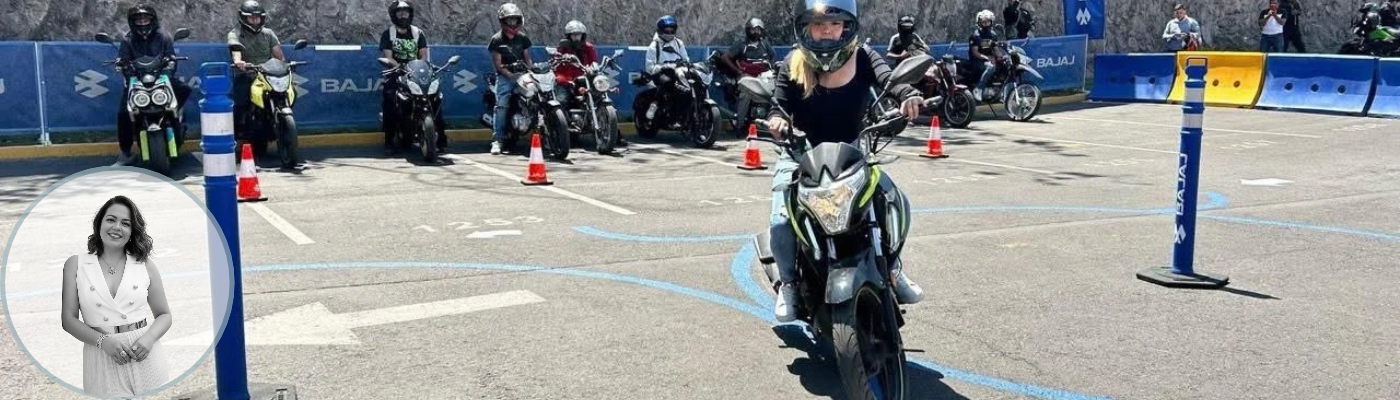
During my time leading the Transport Institute of the State of Mexico, I was directly involved in implementing the mandatory motorcycle rider competency certification scheme required for obtaining a licence, in coordination with the Ministry of Mobility. By the end of August 2026, the scheme had reached 126,000 certifications. In my view, that figure reflects the scale of implementation of the policy; its impact on reducing collisions should be assessed separately. What matters is that it combines skills assessment, training and enforcement within a public policy framework aimed at improving road safety.

Intertraffic: Our two feature on Mexican road safety have had the headline: “ADAPT. INNOVATE. INVENT.” Is this an accurate reflection of how the public sector sees the situation?
CADM: Taking the phrase "adapt, innovate, invent", I see three functions that need to be coordinated from a public management perspective. Adapting means taking proven technologies and assessing their suitability for local conditions. A speed camera, for example, requires more than installation, it needs a clear legal framework, reliable operation, sustained funding and transparent enforcement procedures. Innovating means using the data we already generate to identify risks and decide where to intervene. Inventing creates opportunities to develop our own solutions by connecting research, engineering and specific local needs. My benchmark is not the novelty of a tool, but the problem it can solve and the conditions needed to sustain its use.
I would qualify the idea of infrastructure that thinks for itself. From a public management perspective, my priority is for a technological solution to become a reliable service, with operation, maintenance and clear rules governing data. Legible signs, lighting, safe crossings and speeds appropriate to the surroundings remain part of that service. A layer of sensors cannot replace safe junction design; it must be integrated with it. Nor is detecting an offence enough without a procedure for addressing it consistently and with the appropriate safeguards.
"From a public management perspective, my priority is for a technological solution to become a reliable service, with operation, maintenance and clear rules governing data"
That is why I consider it important to define interoperability standards, responsibilities for data and evaluation criteria at the project design stage. Service continuity across changes of administration is part of its viability. My criterion for assessing an investment, whether public or private, is that it should contribute to a shared system and that its results should be measurable in safety terms. Intelligent infrastructure has value when it translates into timely decisions and demonstrable protection for people.
Intertraffic: Is it fair to say that Mexico is increasingly using technology smartly, but it is not yet a country whose road-safety strategy is principally technology-led?
CADM: I would distinguish between incorporating technology and making the entire strategy depend on it. Cameras for speed management, public transport monitoring through GPS and telematics, and geographical information systems for identifying collision clusters are tools for specific problems. Drawing on my management experience, what I need to know is which decision each tool supports, who is responsible for acting and how its outcome is verified. Installing technology does not, in itself, demonstrate that risk has fallen.
"Drawing on my management experience, what I need to know is which decision each tool supports, who is responsible for acting and how its outcome is verified. Installing technology does not, in itself, demonstrate that risk has fallen."
The Safe System approach brings together speed management, roads that allow for human error, safe vehicles, safe road use and timely post-crash care. Technology cuts across these components but replaces none of them. I would therefore not propose a sequence in which infrastructure is addressed first and technology added afterwards. They should be designed to complement one another, alongside driver training and enforcement. For motorcycles, that integration includes protective equipment, skills assessments and the conditions in which people ride.
I also consider it essential to assess each municipality's capacity. A solution that requires connectivity, specialist maintenance or permanent staff must include a plan for sustaining it locally. I would not assume that the same deployment is viable in every context. My approach would be a phased implementation, with defined responsibilities, identified operating resources and the capacity to remain operational throughout the project's service life.
Intertraffic: In June 2024 the Secretariat of Infrastructure, Communications and Transportation signed an agreement with iRAP to establish the Mexico Road Assessment Programme (MexiRap). Does Mexico use the resulting data to change roads, or to produce better maps of dangerous roads?
CADM: There are earlier examples of assessments being used to guide investment, but I would distinguish those from the specific results of MexiRAP. SICT reported that the licensing agreement for the programme's launch in June 2024 built on the memorandum of understanding signed with iRAP in November 2023. The methodology combines star ratings with investment planning tools. Its purpose is not simply to map risk, but to identify interventions that improve safety for people walking, cycling, riding motorcycles or travelling in other vehicles. When announcing the launch, iRAP reported that assessments covering more than 140,000 kilometres had already been carried out in Mexico through its partners' projects, and that this work had influenced the safety of road investments worth $250 million. These activities predate the formal programme; they are not results produced by MexiRAP after its creation. Nor would I equate an infrastructure rating or a reported investment with an observed reduction in collisions, establishing that relationship requires documentation of the works, the periods compared and the outcomes.
From a management perspective, the important point is to connect the diagnosis with maintenance and upgrading programmes, without making it a condition that brings maintenance to a halt. Assessments can guide which risks addressing and which improvements to include in each intervention. To assess MexiRAP's progress, I would examine which recommendations became projects, which received funding, what was delivered and how safety conditions changed. That is where data move beyond diagnosis and become the basis for a verifiable infrastructure decision.
"From a management perspective, the important point is to connect the diagnosis with maintenance and upgrading programmes, without making it a condition that brings maintenance to a halt"
Intertraffic: Is Mexico making dangerous roads smarter, or making dangerous roads more visible?
CADM: I would distinguish between understanding risk better and demonstrating that a road has become safer. Health-sector reports, collision statistics and infrastructure assessments provide complementary information, but their coverage is not interchangeable. For example, INEGI's Road Traffic Accidents in Urban and Suburban Areas statistics are based on records from areas outside federal jurisdiction. I would not treat them as representative of the road network as a whole or compare them directly with the health sector's national total of road deaths.
In physical terms, a road with good signs or lighting is not necessarily safe in every respect. Actual operating speeds, road restraint systems, protection for those most exposed to risk, and the layout of access points and junctions also matter. My assessment would include these elements and their relationship with collisions. An annual change in injuries or deaths does not, on its own, establish that risk is being identified accurately or that too little action is being taken. We need to examine the coverage of the records, traffic and the interventions undertaken before attributing changes to a particular cause.
I would therefore not present visibility and safety as mutually exclusive alternatives. A better diagnosis helps identify where to act; improved safety is demonstrated when that information leads to interventions and their effects are assessed using comparable data. That is the connection I would seek to document.
Intertraffic:. Can Mexico turn imported road-safety technology and home-grown AI research into a system that actually understands Mexican road risk?
CADM: I see that integration as feasible, but I would pay as much attention to data quality and compatibility as to the algorithms. Imported technology can provide data capture and processing capabilities; domestic research can contribute to adaptation and validation. For the two to work together, we need to establish whether health, traffic, transport operations and insurance records can be linked using consistent criteria. To design that integration, I would review the coverage, georeferencing, updating arrangements and access rules of the available records. That review identifies the specific gaps the project needs to address.
Before applying a model developed in another context, I consider it essential to test its performance using local data and determine what adjustments it needs. Motorcycles, public transport operated under concession, pedestrian movements and the conditions along each corridor must be represented in the analysis. I would not dismiss a model because of its origin, but nor would I assume that its results are transferable without validation. Developing interoperable records and testing on specific corridors can proceed in parallel, provided that the limitations of the information are documented and personal data are protected. PULL QUOTE
Motorcycles, public transport operated under concession, pedestrian movements and the conditions along each corridor must be represented in the analysis
Drawing on my experience in the State of Mexico, an example of the type of analysis I consider useful would be to cross-reference collision locations with the operation of public transport under concession and the alignment of medium-capacity transport corridors. This exercise could identify overlapping risks and inform the assessment of potential intervention sites. Artificial intelligence would add value if it expanded that analytical capability and produced recommendations that could be tested on the ground.
Intertraffic: Finally, if Mexico could take one piece of road-safety technology currently working elsewhere in the world and deploy it nationwide tomorrow, what would it be or is it already doing so?
CADM: To focus on one technology, I would choose Intelligent Speed Assistance (ISA). It helps drivers recognise and comply with the speed limit through warnings or vehicle responses, depending on its configuration. As the European Commission explains, the requirement was extended to all new cars sold in the European Union from July 2024, without applying retrospectively to vehicles already registered. It is not autonomous driving; drivers retain control and can override the system's intervention.
The technical reason for considering it is that speed is a major factor in the likelihood and severity of collisions, as the World Health Organization points out. I would not assume, however, that fitting the equipment is enough to achieve the same outcome in every context. In Mexico, I would assess how accurately speed limits are identified, the quality of road signs, performance under local conditions and drivers' responses. I would also distinguish the scope of a measure for new vehicles from its effect on the vehicle fleet as a whole.
"In Mexico, I would assess how accurately speed limits are identified, the quality of road signs, performance under local conditions and drivers' responses."
I would place it within a comprehensive approach to speed management, alongside road design and enforcement mechanisms such as average-speed enforcement. These are complementary tools, not substitutes for one another. Before discussing an immediate nationwide roll-out, I would need validation results, operating cost information and clearly assigned responsibilities. My basis for deciding on its application would be evidence of how it helps reduce risk, not simply the availability of the device. Thanks to José Azcárate and Montserrat Azcárate of ITS Mexico for their help in arranging the interview and in putting this article together
Share your story
Do you have an innovation, research results or an other interesting topic you would like to share with the professionals in the infrastructure, traffic management, safety, smart mobility and parking industry? The Intertraffic website and social media channels are a great platform to showcase your stories!
Please contact our Sr Brand Marketing Manager Carola Jansen-Young.
Are you an Intertraffic exhibitor?
Make sure you add your latest press releases to your Company Profile in the Exhibitor Portal for free exposure.



Get up to speed on the mobility industry - our newsletter straight to your inbox!